Instrument respiratory protection, fit-test status, inspection evidence, and field coaching so safety leaders can see program risk before it becomes a missed audit or a rushed substitution.
The connected stack begins with equipment that workers can still wear comfortably. Each hardware option should be validated against task exposure, cleaning procedure, battery rules, and site connectivity before a full rollout.
Streams LEL, O2, CO, or H2S fields from compatible monitoring workflows into a supervisor dashboard for confined-space planning.
Uses NFC or BLE identification to connect a worker, training status, and assigned kit without placing personal data on the visible shell.
Flags heat index trends for crews working in FR layers, respirators, or high humidity before supervisors lose situational awareness.
Links ANSI Z359.11-2021 inspection evidence to assets used at height so overdue gear does not move quietly into the field.
The demo view is designed for program conversations rather than surveillance theater. It shows fit-test gaps, training due dates, cartridge schedule exceptions, and inspection status by site. Supervisors can see which task groups need coaching before the next shift, while corporate teams can export records for audit support.
Dashboards should not replace competent-person review or industrial hygiene judgment. They make the review visible, time-stamped, and easier to share with procurement and operations.
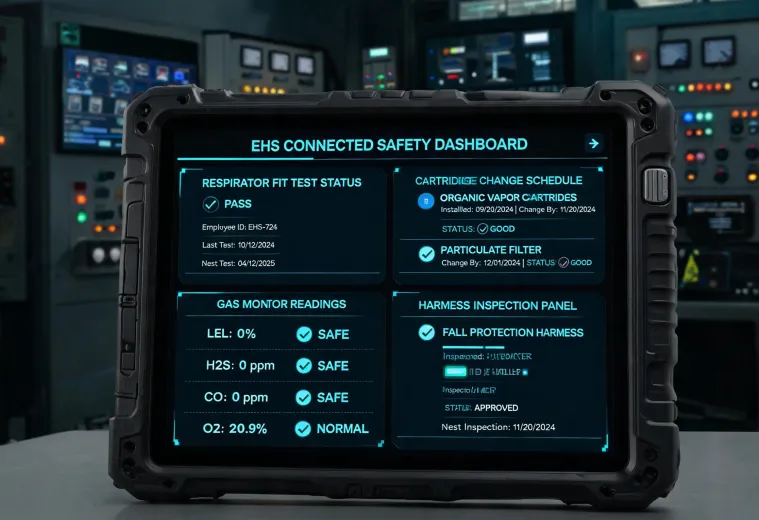
Connected PPE has to land inside the systems that EHS, procurement, and operations already use. A pilot should define data ownership, retention, and integration scope before devices are placed in the field.
Use the calculator as a discussion prompt. Savings depend on your current incident profile, PPE consumption, training effort, and incident investigation cost; no universal result should be assumed.
A focused pilot gives the business enough evidence to decide what should scale, what should stay manual, and which data fields are worth integrating.
Define wearer groups, privacy boundaries, integration owners, and the exact evidence that will be captured.
Deploy devices or digital forms to one site group, observe worker behavior, and adjust training prompts.
Evaluate fit-test gaps, overdue inspections, cartridge change flags, and exception volume by supervisor group.
Confirm operating cost, data quality, worker acceptance, and integration value before the next rollout.
Tell us which site, job family, or exposure profile needs better visibility. We can shape a pilot that respects worker privacy and keeps compliance evidence clear.
Book a Connected-Safety Demo