The Math That Made Me Stop Comparing Price Tags
When I took over office purchasing about four years ago, my buying logic was embarrassingly simple: whichever vendor quoted the lowest unit price won. A box of N95 masks was $3 per unit from one supplier and $2 from another — I bought the $2 ones. Done.
Then finance started noticing a pattern in our department's expense reports. Not a good pattern.
I got called into a meeting to explain why our facility maintenance costs kept creeping up, even though our headcount hadn't changed and we weren't buying anything new. I pulled the records and realized — or rather, finance pointed out — that my unit-price shopping habit was quietly driving up our total spend across a dozen different line items.
This article is about comparing purchase decisions the way I wish someone had shown me four years ago. For each category, I'll put the unit price on one side and the total cost of ownership (TCO) on the other, then tell you which one won.
I'll use three real procurement scenarios to make the comparison concrete: disposable respiratory protection, facility maintenance supplies, and perimeter fencing — because apparently the admin team gets handed projects that go well beyond office supplies.
Respiratory Protection: Why the Cheaper Mask Can Cost More
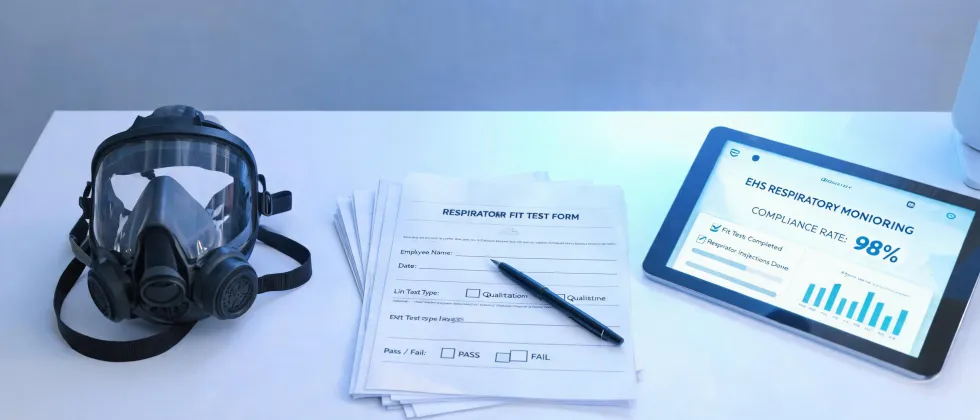
We stock N95 respirators for our maintenance crew. Roughly 200 units a month, sometimes a bit more depending on how many jobs are scheduled. My old approach: get two or three quotes, pick the lowest per-unit price.
Here's what I didn't realize until our safety coordinator pulled me aside.
The cheap respirators had a problem. Employees were pulling them off after an hour or so because they were uncomfortable — bad fit, poor seal, hard to breathe through. Not because the mask failed, but because nobody wanted to keep it on for a full shift.
From the outside, it looks like a cheaper mask simply saves money. What nobody sees is the replacement pattern: employees who take off a mask after an hour end up grabbing a fresh one before lunch, then another one in the afternoon. Your "cheap" mask effectively costs double what the price tag says.
I switched our standing order to the Moldex 2200 N95 particulate respirator — roughly $2.50-3.50 per unit depending on order volume, per quotes I got back in late 2024. That's more per piece than our previous supplier. But here's the thing: the fit is consistent and the exhaust valve makes it tolerable for long periods. Our monthly consumption dropped. I want to say by about a third, though I don't have hard data on that — I just know I stopped getting complaints and the reorder frequency slowed down.
What most people don't realize is that PPE has a hidden cost dimension: the cost of non-use. If employees won't wear a respirator because it's uncomfortable, then the protection isn't happening. And the compliance exposure, the downtime, the potential health issues — none of that shows up on the unit price tag. But it accumulates.
Moldex SparkPlugs soft foam earplugs follow the same logic. The unit price might look higher than the generic box you find on Amazon. But once you factor in how long employees actually wear them (and whether they keep them in long enough to meet OSHA requirements), the math shifts. OSHA 1910.134 requires that respirators be selected based on workplace hazards and user comfort — which means the "cheapest" option might not even satisfy the regulation.
The bottom line for this category: unit price tells you what you paid once. TCO tells you what you'll actually spend over time.
Facility Supplies: Costs That Hide in the Fine Print
Facility maintenance supplies are where unit-price thinking gets especially expensive — mostly because the hidden costs don't announce themselves until months later.
Take smoke detector batteries. I used to bulk-order whatever was cheapest per battery. Cheaper batteries have a shorter run time. That means you replace them more often. Every replacement means someone has to grab a ladder, find the detector, swap the battery, and log it. We have roughly 180-200 detectors across our building — I don't remember the exact count, but enough that a full swap takes the better part of a day.
When you add staff time to the battery cost, the cheaper option stops being cheaper. Long-life lithium batteries cost more per unit, but they last three to five years instead of one. The math: a $1.50 battery replaced every year for three years costs $4.50 in materials, plus three rounds of labor. A $6 battery that lasts five years costs $6 total, plus one round of labor. The number looks bigger on the invoice. It's smaller on the budget report.
The sewer gas detector I bought a few years ago followed the same pattern. I chose it on unit price because I didn't know any better. Then I got the calibration quote. Calibration services for gas detection equipment typically run $100-250 per session, and most industrial sensors need calibration every 3-6 months. That "bargain" detector needed calibration twice a year. The calibration cost happened to be about half the purchase price each time. I hadn't budgeted for any of it.
We didn't have a formal approval process for equipment purchases back then. The third time an unexpected maintenance charge showed up on a quarterly report, I finally created a simple form that requires every equipment request to include a one-year projected maintenance cost. Should have done that after the first surprise.
Here's something vendors won't tell you: the purchase price and the maintenance cost are often designed as separate line items for a reason. If you only ask for a quote on the equipment itself, you're hearing half the story.
For anyone wondering about smoke detector battery replacement — the process itself is straightforward. Open the housing, remove the old battery, match the size and voltage (most standard detectors use a 9V), and press the test button. NFPA 72 recommends testing detectors monthly and replacing batteries annually, though long-life models can stretch to 3-5 years. But the real cost isn't in the process — it's in how often you have to repeat it.
Perimeter Fencing: Where the Real Lesson Hit
If the first two examples didn't fully convince me to think in TCO, the fencing project did.
Last summer we needed wrought iron fence installed along the warehouse perimeter. I got two quotes: one came in about 30% lower than the other. I nearly approved it on the spot.
I knew I should get a written breakdown of what the quote covered, but thought "we've done due diligence, it's probably fine." That was the one time it mattered. The cheaper quote excluded the on-site survey fee ($150), and the base paint was standard from stock rather than rust-proof coating (another $400 to upgrade). The higher quote was all-inclusive: survey, premium coating, installation, and a five-year warranty. Once I added up the cheaper option's extras, the total came within a few hundred dollars of the higher quote — and the warranty coverage was two years shorter.
My rough math: the all-inclusive quote worked out to about $35-40 per linear foot installed. The "cheap" one would have landed in a similar range once the add-ons were factored. Not identical — but close enough that the warranty difference became the deciding factor.
I now use the same framework for every purchase comparison that has any complexity:
- Unit price — the number that's on the quote
- Add-on fees — shipping, installation, setup, training
- Labor — your team's time or the vendor's hourly rate
- Maintenance — consumables, calibration, servicing, replacement parts
- Risk cost — warranty length, return hassle, compliance exposure
Add up all five, and you get a number you can actually compare. Ignore the last three, and you're comparing fractions.
When Unit Price Is the Only Thing That Matters
I should be honest: TCO thinking isn't for everything. Some purchases genuinely don't need the full analysis.
Office supplies like sticky notes, dry-erase markers, and toner cartridges — those are unit-price decisions. The difference in consumable quality is negligible, there's no maintenance cost, and the time you'd spend building a TCO model costs more than the savings.
But three categories where I always go through the TCO math now:
- Safety gear (respirators, earplugs, safety glasses) — wear time and compliance are part of the cost calculation, whether they're on the invoice or not
- Equipment with maintenance obligations (detectors, filtration systems, calibration-dependent devices) — the purchase price is the down payment, not the total cost
- Installed infrastructure (fencing, ventilation, flooring) — one-time install plus ongoing upkeep, calculated together
If you only compare the unit prices on those three, you're basically guaranteed to underbudget. I've done it. The surprise invoice is never fun.
How to Apply This to Your Next Purchase
Three things I'd tell anyone starting to manage procurement:
First, run both numbers. Put the unit prices side by side. Then put the TCO estimates side by side. If they point to the same vendor, great — go with confidence. If they point in opposite directions, that's your cue to dig into why.
Second, ask the question vendors don't volunteer. "What does this price include, and what does it not include?" Warranty, installation, calibration, shipping, disposal of old equipment — those are the four or five places where extra costs tend to appear two months later.
Third, use a threshold. If the unit prices are within 15-20% of each other, just go with the lower TCO and save yourself the deliberation. If the gap is bigger than 30%, do the full analysis before committing. Anything in between is a judgment call — and probably depends on how long you plan to keep the item.
I can't say I get every purchase decision right now. I don't. But I've stopped making decisions that only look good on the quote sheet — and that alone has saved our department more than any single negotiation I've ever run.
Price references are based on market quotes from late 2024 to early 2025. Actual pricing varies by vendor, quantity, and timeline — verify current rates before making purchase decisions.