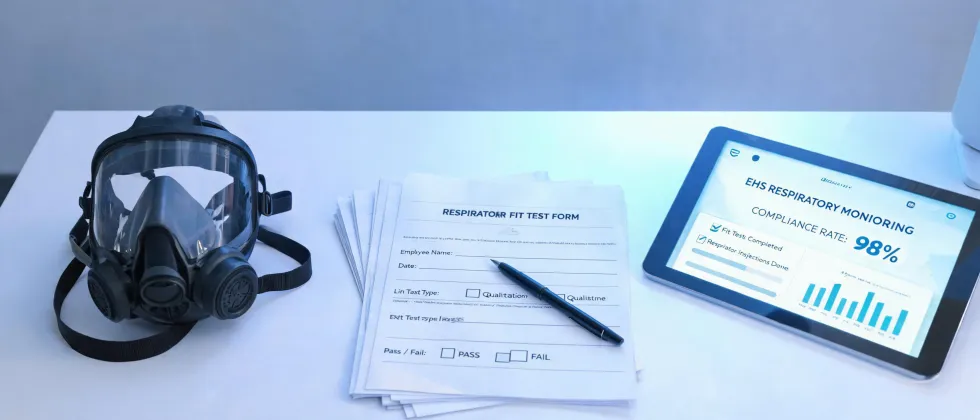
I'll say it upfront: a 3M respirator is only as good as the fit-testing, training, and cartridge selection behind it. That opinion didn't come from a brochure. It came from six years of buying safety gear for a 240-person industrial contractor.
I manage 60 to 80 orders a year, roughly $90,000 in purchases across 14 vendors. I'm the office administrator who sits between a production supervisor saying 'we need it now' and a finance team that hates surprises. My job is not glamorous, but it taught me a lot about when the right product is the wrong purchase.
What I got wrong about 3M respirators
When I took over purchasing in 2021, I assumed a 3M respirator was a self-contained solution. We deal with metal dust, silica, paint overspray, and solvent vapors. I picked cartridges, added a box of N95s, and considered it done.
Then a new safety consultant asked where our written respiratory protection program was. I didn't have one. I asked, 'Which 3M respirator should I buy?' He answered with another question: 'Which mask, for which worker, for which contaminant, with what cartridge?'
He wasn't being difficult. He was applying OSHA's respiratory protection standard, 29 CFR 1910.134. When a respirator is required because of an airborne hazard, tight-fitting respirators require a medical evaluation and a fit test before first use, and at least annually after that. No tight-fitting respirator can seal where there's facial hair at the sealing surface. No random cartridge will stop every vapor. That was my mistake: I treated a respirator as a SKU instead of a process.
The frustrating part is that I had spent a real chunk of budget on a good 3M respirator while missing everything around it. Buying the respirator was the easy 10%.
Leather welding gloves taught me about cost per hour
Leather welding gloves were a different kind of wake-up call.
In early 2024, our welding supervisor asked me to buy two types of leather welding gloves for his crew to test before we stocked a full year. I thought it was overkill. The trial paid off.
The cheaper pair cracked and shrank after a couple weeks of real work. The sturdier pair lasted longer, and the welders said the seams were more comfortable. The 'expensive' gloves ended up costing less per hour of wear. I keep the math rough: if a $12 pair lasts 2 weeks and a $20 pair lasts 8 weeks, the $20 is the cheaper buy.
That doesn't mean every shop needs premium leather welding gloves. For someone who welds once a month, a basic pair is probably fine. But if you treat gloves as one-size-fits-all, you're not choosing protection—you're just guessing.
Single-use earplugs: what 'professional fitting' really means
The phrase 'single-use earplugs require a professional fitting before they can be used' gets repeated in safety conversations. I used to dismiss it as exaggeration. Now I think it's half right.
Most single-use foam earplugs don't need an audiologist to custom-mold them. They do need someone trained to watch the insertion technique. During our hearing conservation training, every employee takes out the earplug, rolls it, pulls the ear up and back, inserts it, and waits for the foam to expand. If the earplug sits halfway out, real-world attenuation can drop close to nothing.
OSHA's hearing conservation regulation, 29 CFR 1910.95, is built around proper fitting and training, not custom fitting. So if the statement means 'nobody should hand out earplugs without any training,' I agree. If it means 'you need a clinical fitting for every disposable pair,' that's overstating it. The lesson is the same as with the 3M respirator: user training is part of the product.
3M certified installers: buying a system, not a label
I'll admit my least favorite part of procurement is when a manufacturer says a certified installer is mandatory. My first reaction is always that this is just price protection. Sometimes it is. But 3M certified installers changed my mind.
We put 3M safety/security window film on a ground-floor office. A local handyman quoted half the price of the 3M certified installers. I was tempted. Then I checked the product warranty and our insurance review; both expected documented installation by 3M certified installers. An uneven edge or contaminated glass can ruin the film's performance, and you might not see the problem until the film is tested.
I recommend using 3M certified installers when the manufacturer requires them, especially for security-related materials. This recommendation doesn't apply to everything. You don't need a certified installer to replace a cartridge on a 3M respirator or to rotate a stock of leather welding gloves. The key is knowing when the product only works as a system.
Pepper gel vs pepper spray: same logic, different scenario
Pepper gel vs pepper spray came across my desk when a regional office asked me to look into personal defense supplies. It isn't a 3M question, but it belongs in the same argument.
Pepper gel vs pepper spray is less about which option is stronger and more about where and how it would be used. Gel shoots a stream and sticks to the target, which means less airborne drift. Spray can cover a wider area, but the mist can blow back onto the user, contaminate a room, and affect bystanders. There are also legal and policy questions. If carrying the product isn't allowed, or if your security team's use-of-force policy doesn't cover it, the chemical comparison doesn't matter.
The objection I keep hearing
By now you might be thinking, 'This works for a contractor with time to do fit tests and wear tests. We don't have that.' I understand. I almost used the same excuse.
Then an insurance auditor asked for our fit test records. I spent three days chasing paperwork, and one missed record would have created a much larger headache. A simple, documented program beats a perfect product list with no program. That's a hard lesson to put on a purchase order, but it's real.
There's an honest limitation here. Not every 3M product needs the same ceremony. A 3M respirator needs fit testing and correct cartridge selection. Leather welding gloves need task-based selection and a wear test. Single-use earplugs need insertion training. 3M certified installers are only necessary when installation is part of performance. The common failure isn't the equipment; it's the assumption that gear alone is enough.
After all this, I still buy 3M for a large part of our safety program. I'm not anti-brand, and I'm not claiming every generic product is dangerous. What I've learned is more specific: buying the right item matters, but buying it alone is not enough. Safety shows up in the fit test room, in the two-minute earplug demonstration, in the installer contract, and in the decision to say, 'this product is not right for this situation.' That last part is the hardest thing to budget for. It's also the thing I'd fight for first.
There's something satisfying about seeing a worker correct their own earplug insertion without being told. That's when a procurement decision becomes a safety outcome.