-
Question 1: Are 3M Virtua safety glasses really ANSI Z87.1 rated?
-
Question 2: What is '3M safety tape'? Is it the same as duct tape?
-
Question 3: Half face respirator or N95: which one do I actually need?
-
Question 4: What is the 3M Lift hard hat?
-
Question 5: What is a fall arrest system?
-
Question 6: Is paying extra for fast delivery on 3M PPE ever worth it?
For the last 11 years, I've handled PPE ordering for a medium-sized construction and industrial maintenance company. I've personally made—and documented—eleven significant purchasing mistakes, totaling roughly $12,000 in wasted budget. Now I maintain our buying checklist. This article isn't a substitute for your own safety professional. It's the list of questions I actually get from new supervisors, plus answers I learned the hard way.
Here's what I'm covering:
- Are 3M Virtua safety glasses really ANSI Z87.1 rated?
- What is '3M safety tape'?
- Half face respirator vs. N95: which do you need?
- What is the 3M Lift hard hat?
- What is a fall arrest system?
- Is expedited shipping worth the extra cost?
If you're in a hurry, skip to the last answer.
Question 1: Are 3M Virtua safety glasses really ANSI Z87.1 rated?
Yes—the standard 3M Virtua models carry a Z87 or Z87+ mark on the frame or lens, which means they've been tested against the impact and optical requirements in ANSI/ISEA Z87.1-2020. Look, that mark is not just marketing. The lens has to survive defined impact tests, and the frame has to be designed to keep the lens from popping out. In my first year (2014), I ordered 500 pairs of 3M Virtua glasses with a smoke indoor/outdoor tint. Looked fine in the catalog. Then a crew complained they were too dark in the assembly area. That was a $600 mistake: the glasses met Z87.1, but they were the wrong tint for the job. So the question isn't just 'do they meet the standard?' It's 'do they fit the task and the face?' Virtua glasses are good value for general impact and dust, but for splash or overhead debris, you may need goggles or a face shield.
Question 2: What is '3M safety tape'? Is it the same as duct tape?
No, not even close. When someone says '3M safety tape,' they almost always mean 3M Safety-Walk™ anti-slip tape. It's a roll of abrasive material with an adhesive backing, used on stairs, ramps, catwalks, and any surface where people slip. There's also 3M floor marking tape, which is a different thing—that's for visual floor boundaries, not traction. Here's the mistake I made in 2018: ordered Safety-Walk for a wash-down area and skipped the surface prep because the floor looked clean. Three weeks later it was peeling. The label says the surface needs to be clean and dry. We didn't do that, so we lost the product, the labor, and almost lost a worker who caught a boot on the lifted edge. Speed and price matter, but prep matters more.
Question 3: Half face respirator or N95: which one do I actually need?
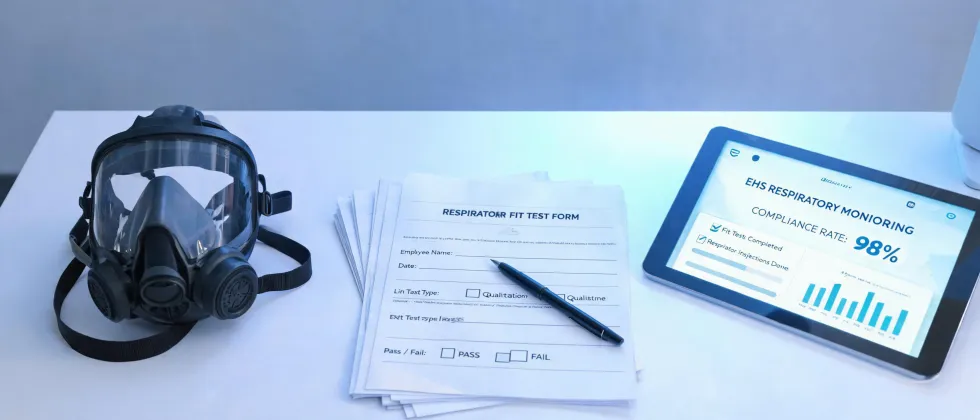
First, an N95 is also a respirator if it's NIOSH-approved. The real question is what hazard you're protecting against. A half face respirator uses replaceable cartridges, so it can filter particles, organic vapors, or both depending on the cartridge. An N95 is only for particles. If your crew is exposed to solvent fumes, welding fumes with specific contaminants, or certain paints, a half face respirator is more likely the right call. But—and this is the part that gets ignored—a half mask only works if it fits and if your people are trained. Under OSHA's respirator standard (29 CFR 1910.134), mandatory use requires a medical evaluation, fit test, and training. I learned this in 2021 after buying 50 half face respirators for a crew and skipping fit testing. Figured one size would cover everyone. The leak test said otherwise. Don't buy cartridges until you've identified the contaminant; read the SDS and ask your supplier.
Question 4: What is the 3M Lift hard hat?
'Lift' is the model name, not a feature. It's a lightweight hard hat with a ratchet suspension, designed for all-day comfort. But honestly, the model name doesn't matter much—what matters is the label inside the shell. ANSI Z89.1 categorizes hard hats by type (Type I or Type II) and electrical class (G, E, C). Type I protects the top of the head; Type II adds lateral protection. Class G is rated to 2,200 volts, Class E to 20,000 volts, and Class C is conductive and not for electrical work. In Q2 2022, I almost ordered a Class C hard hat for a crew doing panel work. The inside label said Class C. One phone call caught it. Dodged a bullet there. Always verify the class on the sticker, not the model name.
Question 5: What is a fall arrest system?
A fall arrest system is the complete setup that stops a worker before they hit the lower level. It's not just a harness. OSHA's construction rule (29 CFR 1926.502(d)) lists three essential parts: an anchorage, a full-body harness, and a connecting device—usually a lanyard or a self-retracting lifeline. The anchorage has to hold 5,000 pounds, and the connecting device has to be short enough that the total fall distance doesn't let you contact the ground or a lower obstruction. In September 2022, I ordered lanyards for a crew based on the height of the platform—but nobody checked where the D-ring sat or how much the lanyard would stretch. The reorder cost $1,200 and delayed the job two days. Also remember the rescue plan: an arrested fall is an emergency, and workers hanging in a harness need to be brought down quickly. Fall protection is one area where the cheap option is never cheap.
Question 6: Is paying extra for fast delivery on 3M PPE ever worth it?
I used to think expedite fees were a scam. Then I got burned twice by vendors who said 'probably on time' and showed up three days late on a shutdown job. Now I see it differently: with urgent PPE, you're not paying for speed. You're paying for certainty. In March 2024, we paid $430 to expedite half face respirators and cartridges for a new line startup. The alternative was delaying a $15,000 day of production. The fee wasn't cheap, but the delay would have been a lot worse. The key is to get a written delivery date, not just 'we'll ship it fast.' And not every order needs expediting. If the job is next month and the standard date fits, keep your money. The 'certainty premium' is for when missing the deadline has real consequences. That's the lesson that has saved me far more than the $12,000 I lost on my early mistakes.
