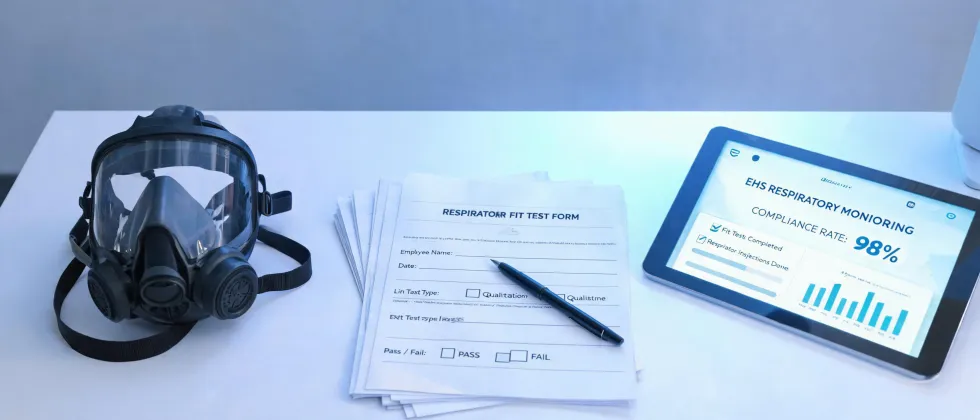
In March 2024, a site manager called me at 11 p.m. They needed 60 full-face respirators with P100 cartridges for a valve repair that had to start in 36 hours. Normal lead time was five days. "Just find them," they said, "I don't care what it costs."
I found boxes with the 3M logo at 40% below wholesale. It felt like a no-brainer. It wasn't. The cartridges didn't have an NIOSH approval number, and when we checked the lot number with the manufacturer, it didn't exist. That call taught me something I've seen repeated across 200+ rush orders: when people are in a hurry, they use the 3M logo as a shortcut. Counterfeiters know this better than anyone.
The 3M Logo Is Not a Supply Chain
Everything I'd read about buying safety products said the same thing: look for the 3M logo, check the approval mark, and buy from a reputable seller. In practice, I found that the logo is probably the least useful part of verification. It's just a visual anchor. A counterfeit maker can print a very convincing 3M logo on a box in about ten minutes. They can print "NIOSH approved" too. What they can't easily fake is the chain of custody: the batch code, the legal entity, and the authorized distributor.
Let me rephrase that. A 3M logo on a product means "this is intended to look like a 3M product." It doesn't mean "this came from 3M." In Europe, a legitimate invoice will often reference 3M S.r.l. (or 3M Srl on some commercial documents) as the seller. That legal entity is a traceable link. If you see a logo without a traceable seller and batch number, that's a red flag—no matter how urgent the order is.
The "logo = genuine" thinking comes from an era when fake goods were poor quality and easy to spot. Today, counterfeiters have high-res printers and packaging that looks pretty real at a glance. To make matters worse, some suppliers don't even intentionally sell fakes—they buy from a discount import broker who promises "3M compatible" and ends up delivering something that just looks similar.
Why I Explain Safety With Three Fences
Now, the deeper issue. A respirator is a barrier—same as a fence. But most people evaluate a barrier by its label, not by whether the barrier actually holds.
I sometimes explain this using three different fences. A PetSafe invisible fence keeps a dog in the yard only if the boundary wire, the collar, and the training all work together. A silt fence on a construction site stops sediment only if the fabric is trenched into the ground, the stakes are driven deep, and there are no gaps. And a Minecraft fence gate—bear with me—only blocks a gap if you place it in the gap and close it. If you've ever searched "how to make fence gate in Minecraft", you know the crafting recipe is the easy part. The hard part is building a wall that actually has a working gate.
Safety products are exactly the same. A 3M half-mask with a counterfeit cartridge is a fence gate with a missing hinge. A fall harness with an unapproved replacement buckle is a silt fence with a tear under the surface. A hearing band with mislabelled attenuation is a PetSafe invisible fence with a dead collar battery. The 3M logo on the outside doesn't change any of that.
The Part Nobody Checks Until It Fails
Even when you confirm the product is genuine, there's another gap: fit and compatibility. A P100 cartridge does not automatically create an airtight seal just because it has a 3M logo. It needs the correct mask, a clean sealing surface, and a user who has been fit-tested. OSHA 29 CFR 1910.134 requires fit testing for tight-fitting respirators for a reason. The same logic applies to hearing protection and fall protection.
I've seen companies buy a 3M PAPR system for the wrong job, or buy a half mask without checking whether the filter thread is compatible with the cartridges they already have. It's sort of like trying to put a fence gate into a wall that wasn't built for it. The gate might look right, but it won't close properly, and the gap is exactly where the problem gets in. In my experience, compatibility issues cause more lost time than counterfeit product on its own—because they're harder to spot.
The Cost of Trusting the Logo
Let's talk about what this costs. In 2023, a client of ours lost a $50,000 contract because a batch of gloves failed tensile testing. The gloves looked right and had a printed logo from a well-known brand, but they were not traceable to the original manufacturer. The site had to stop work for three days, and the penalty clause outweighed any savings from buying the cheap version.
In another case, a manager paid $800 extra in rush freight for what turned out to be counterfeit respirators. On top of the $800, they paid for the correct 3M units with expedited shipping again, plus a fit-testing session. The real cost wasn't the rush fee. It was the loss of a day and a half, the credibility hit with the crew, and the possibility that someone could have been exposed before the error was caught.
I want to say that was an isolated incident, but it's been a pattern. When I'm triaging a rush order, I now spend the first few minutes verifying before I ever quote a delivery date. "Fast" and "correct" are both non-negotiable, but "correct" comes first. If you're not sure what you're buying, you're not saving time. You're adding a second emergency to the one you already have.
How We Handle Urgent 3M Requests Now
Here's what actually works. I've had to source 3M products in under 48 hours more times than I can count, and the process is pretty boring:
- Verify the 3M logo, then ignore it. The logo gets you to the right category; it doesn't verify the item. Check for an NIOSH approval number in the US or EN 143/EN 140 markings in Europe. Look for a lot or batch code that you can cross-reference with the manufacturer or an authorized distributor.
- Confirm the legal entity. If an invoice says 3M Srl or 3M S.r.l. or another official 3M entity, that's a good sign. If it says "3M compatible" or arrives from a random reseller with no issued invoice? That's a red flag. What I mean is, don't accept vague labels when you need verifiable ones.
- Build a 48-hour buffer. Our company policy now requires a 48-hour buffer for all critical PPE purchases, because of what happened in 2023. That buffer is what allows us to check batch numbers and still make the deadline. If you truly can't build a buffer, keep a list of authorized distributors who can provide a certificate of authenticity within two hours.
Bottom line: the 3M logo is a starting point, not a safety plan. A PetSafe invisible fence, a silt fence, and a Minecraft fence gate all taught me the same lesson—a barrier only works if the whole system is intact. Same with your respirator, your harness, and your hearing protection. I'd rather spend ten minutes explaining how to check this stuff than spend ten days explaining why a bad product shut down a project.
If you're about to place an urgent order for 3M products, slow down enough to verify the seller. It's not about being slow. It's about not making the problem worse.
