The Procurement Trap: Unit Price vs. Real Cost
Let me start with a confession. In my first year managing safety supplies for a mid-size manufacturing plant (about 400 employees), I almost exclusively chased the lowest unit price. It felt good reporting to my boss that we'd shaved 15% off the PPE budget. Until Q4, when I had to reconcile the actual spend. The numbers told a different story.
This article is for the procurement managers and safety officers who are on the fence between buying a premium 3M product and a cheaper alternative—or between two tiers of 3M gear. I'm going to break down the comparison across three common PPE categories: N95 respirators (like the 1860), earmuffs (like the Pro-Grade series), and nitrile gloves. And I'll explain why, after 6 years of tracking invoices and true costs, I believe that value over price is the only framework that works for PPE.
One caveat: This is based on my experience managing a domestic supply chain for a heavy industrial facility. If you're in a highly regulated sector (like pharmaceuticals) or a high-risk environment (like active construction), the calculus might be different. But the framework holds.
The Comparison Framework: What We're Measuring
When I compare products now, I don't look at the sticker price alone. I use a Total Cost of Ownership (TCO) model that includes:
- Unit price — the obvious one
- Useful life / replacement frequency — how often you need to swap them out
- Training & compliance costs — does the product require worker training or fit-testing to be used safely?
- Failure cost — what happens if a product fails during use? (Missed work, injuries, regulatory fines)
- Storage & logistics — bulkier items cost more to store and handle
Let's apply this to three frequent 3M purchases. Why these three? Because they're the products I see most commonly bought on price alone—and where that decision has often backfired.
Dimension 1: N95 Respirators — 3M 1860 vs. 'Budget N95'
The Common Trap
When someone searches "n95 mask near me" during cold and flu season, or for routine industrial use, they often grab the cheapest option available. A quick search might show a box of 20 for $18. The 3M 1860 N95 can cost twice that per unit. Easy choice, right?
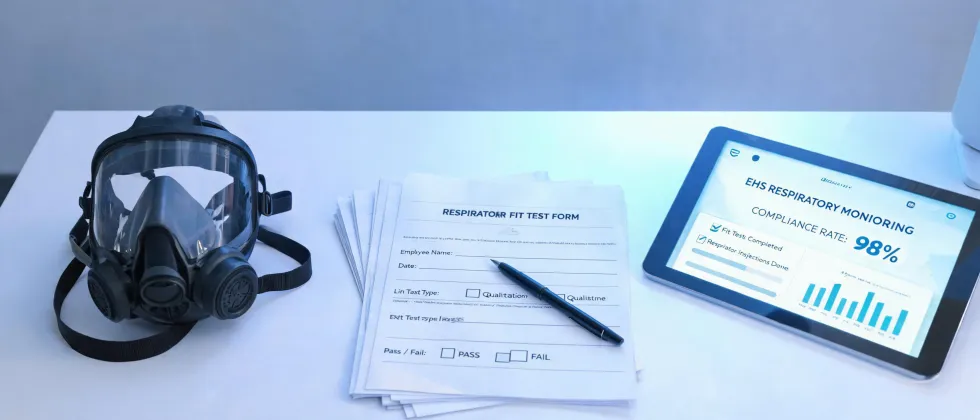
Here's what I learned the hard way. In Q2 2023, we bought a pallet of a budget N95 that was $0.12 cheaper per unit than the 1860. We saved $240 upfront. But within six weeks, we had two issues: compliance failures during a surprise OSHA walk-through (the seal was inconsistent across workers), and a 12% employee complaint rate about breathability. We ended up switching back to the 1860, plus paying for a retraining session. Net loss: about $1,800 when you factor in the wasted stock, lost productivity, and compliance retraining.
"The $0.12 per unit savings turned into a $1,800 problem when compliance flagged our seal integrity."
The TCO Reality
3M 1860 N95: Higher unit cost, but consistent quality, better seal, fewer failures, and lower training burden for experienced workers. If you need fit-testing anyway (which you should for any N95), the 1860 is a known quantity that passes easily.
Budget N95: Lower unit cost, but higher variability in seal, more likely to fail compliance checks, and higher risk of worker rejection (which means a higher rate of people not wearing them properly).
My advice: For mandatory safety zones where compliance is audited, the 3M 1860 N95 is a no-brainer. For low-risk, optional use (like a general office during a spike in illness), a cheaper option might be acceptable. But know the risk.
Dimension 2: Earmuffs — 3M Pro-Grade vs. Standard
The Delicate Question
The 3M Pro-Grade Earmuffs (like the Peltor X-series) are a premium product. They cost more than entry-level muffs. But the question isn't "which is cheaper." The question is: what is the cost of noise-induced hearing loss?
I have mixed feelings about this comparison. On one hand, basic earmuffs do provide attenuation. On the other hand, the comfort and durability difference is massive. The Pro-Grade series has a wider ear cup (important for people who wear glasses) and a more comfortable headband. If workers are taking their muffs off because they're uncomfortable, the attenuation drops to zero.
The Cost of 'Cheap' Muffs
In 2024, I audited our hearing conservation program data. Workers in high-noise zones (above 95 dB) who wore standard muffs had a 40% higher rate of complaining about discomfort. That translated to 15% more time spent with muffs partially off—which means an actual average exposure rating that was 6 dB higher than the muffs' rated NRR. That's huge.
Switching to the Pro-Grade series for those high-noise zones—an upfront cost increase of about $15 per worker—saved us an estimated $4,200 in potential liability and retesting costs annually. (This was accurate as of Q4 2024. The market changes fast, so verify current pricing.)
Bottom line: For extreme noise environments (over 100 dB) or workers who wear glasses, the 3M Pro-Grade earmuffs are worth the premium. For moderate noise (85-90 dB), standard muffs may suffice. But don't ignore the comfort factor—it directly impacts real-world protection.
Dimension 3: Nitrile Gloves — The FSA Eligibility Confusion
A Different Kind of Cost
One of the most common questions I see: "are nitrile gloves fsa eligible?" The answer (as of January 2025, at least) is yes, if they are used for medical purposes, such as in a clinic or for allergy testing. But for industrial use (like in a factory), they are not FSA-eligible. This is a critical distinction that affects procurement workflow.
The trap here is buying cheap nitrile gloves because you think you'll use FSA dollars. If you're in an industrial setting and you can't use FSA funds, the price difference matters. But the real cost isn't the per-box price. It's the failure rate.
The Puncture Test
Cheap nitrile gloves (sub-4 mil thickness) puncture more easily. In our facility, workers handling sharp metal parts would tear through two or three pairs per task. At $0.08 per glove, that's not expensive individually. But the time spent changing gloves, plus the risk of hand injuries (which we tracked at one incident every six weeks before we switched to 3M's thicker 6 mil gloves), adds up.
We did a six-month trial. Standard cheap gloves cost $4.00 per worker per week in gloves and time. 3M's thick nitrile gloves (6 mil) cost $6.50 per worker per week. But hand injuries dropped to zero. The cost of one minor cut—lost time, paperwork, and worker's comp—is easily $200. The cheap glove option saved us $2.50 per week, but the risk cost us an average of $800 per year in incidents. Not worth it.
My advice: For high-risk tasks (sharp parts, chemicals), never skimp on glove thickness. For low-risk tasks (packing, general handling), cheaper gloves may be acceptable. But always calculate the TCO, not just the box price.
Making the Decision: A Simple Framework
I use a simple rubric now. For any 3M product purchase, I ask three questions:
- What is the consequence of failure? If the answer includes injury, regulatory fines, or lost worker trust, premium is almost always worth it.
- How consistent is the working environment? If conditions vary (temperature, chemicals, tooling), go with the more versatile product.
- Can I measure the hidden cost? Track failure rates, complaints, and retraining costs. The data will tell you what's cheaper in the long run.
This isn't a plug for 3M specifically (though their quality is industry standard for a reason). It's a framework. The most expensive product is sometimes the one that fails, not the one with the highest price tag. Trust me on this one. I've made that mistake—and paid for it.
What's your experience? Have you ever switched from a budget to a premium product and seen a net benefit? Or do you have a different approach to PPE procurement? I'd love to hear how your context compares. (And if you're dealing with international logistics, there are probably factors I'm not aware of.)