-
1. Are 3M respirator cartridges interchangeable with other brands?
-
2. Are 3M push-in earplugs reusable?
-
3. Is a pet safe wireless fence good enough for a work zone?
-
4. Why do I keep saying aluminum fence post instead of just post?
-
5. Can you check pepper spray on a plane?
-
6. What's the biggest PPE ordering mistake that wastes money?
I'm an EHS coordinator who's been handling safety equipment orders for nine years. In my first year (2017), I made the classic rookie mistake: I ordered the wrong 3M respirator cartridges for a crew of 12—$890 wasted, plus a week of delays. That was the first time I documented my own error, not to feel bad about it, but to avoid repeating it. Since then, we've caught 47 potential errors using a simple checklist in the past 18 months. Here are the questions I wish someone had answered before I learned the expensive way.
1. Are 3M respirator cartridges interchangeable with other brands?
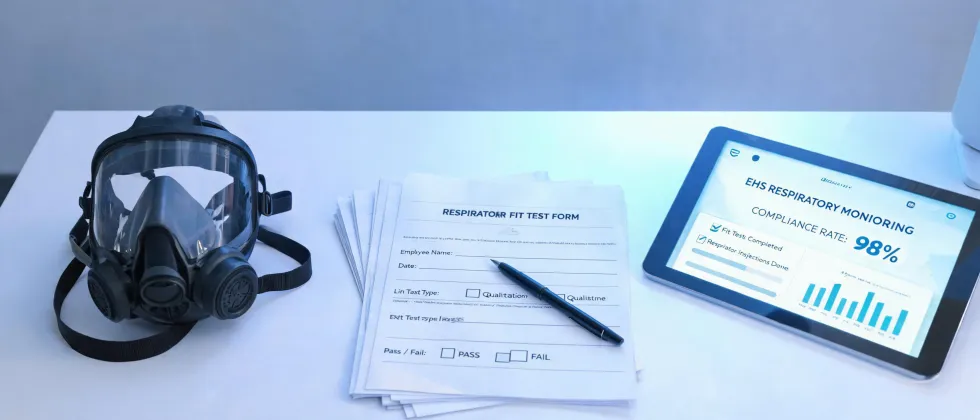
Short answer: usually not. It's tempting to think any bayonet-style 3M respirator cartridge will fit any facepiece, especially when the photos on a supplier website look the same. But NIOSH approval is given to the full system—facepiece plus cartridge—not to the cartridge on its own. If you put a 3M cartridge on another brand's mask, or a third-party cartridge on a 3M facepiece, you don't have a certified respirator. You have a collection of parts.
I learned this in September 2022. I said 'standard 3M cartridges' to a new supplier. They heard 'whatever cartridges are standard.' We got a pallet of universal-type cartridges that didn't seal properly against our 3M facepieces. The crew noticed the fit test failure before I did. That mistake cost $1,150 and three days of lost work. It's not just a budget problem; it's an OSHA 1910.134 compliance problem.
Now we verify the 3M cartridge part number and the facepiece model before finishing the purchase order. The facepiece often has a model number on the inside or cheek. If the numbers don't match a NIOSH-approved system, we don't order it. It's a boring process, but it works.
According to NIOSH (cdc.gov/niosh), approval applies to the combination of respirator components, not to individual pieces. Mixing brands or models can void that approval.
2. Are 3M push-in earplugs reusable?
Most 3M push-in earplugs are disposable. The push-in stem makes them easier to insert without rolling the foam, but it does not make them reusable like custom-molded plugs. Once the foam gets dirty, compressed, or loses its shape, the noise reduction drops. 'I'll just use them one more week' is how hearing loss happens—usually not overnight, but slowly, shift after shift.
The surprise wasn't the earplug cost; it was how much time we wasted arguing about reuse. A guy on the line would keep the same pair for a month and swear they still worked. We created a one-container-per-shift system in our shop, with a fresh pair at the start of each shift. That simple flow cut our hearing protection issues by more than half. A written rule, not a verbal 'don't reuse them,' made the difference.
Also, don't trust the old back-of-box NRR number as a guarantee. The NRR comes from lab testing with trained test subjects, not from your individual ear canal. Push-ins are fast, but 'fast' doesn't mean 'effective' if you don't seat them properly. I tell every new hire: clean hands, pull the ear up and back, insert, hold until the foam expands.
3. Is a pet safe wireless fence good enough for a work zone?
No. I get why people ask: a pet safe wireless fence seems like a fast, low-tech boundary. You bury nothing, install nothing, and the collar beeps when an animal gets near the edge. But it's designed to correct a pet with a collar, not to physically stop a worker from walking into a hazard. It's a training tool for dogs, not a containment system for people.
A construction supervisor once proposed a pet fence to mark a temporary excavation area. He saw the price and thought it was a clever shortcut. We talked it out before installation—otherwise we would have had a boundary that stopped no one. The collar-based signal only works when the person is wearing the receiver. In a loud work environment, nobody hears the warning tone, and nobody wants a shock collar. (Which, honestly, should have been the first red flag.)
For worker safety, you need a visible physical barrier. That means fence panels and an aluminum fence post anchored properly, not a radio wave and a beeping collar. A physical barrier doesn't need batteries.
4. Why do I keep saying aluminum fence post instead of just post?
Because in temporary fencing, the post is usually the weakest link. I once ordered lightweight plastic posts for a construction site because they were cheap. A windstorm turned seven panels into sails and snapped two posts. (Ugh.) The replacement aluminum fence posts were not the cheapest option, but the labor savings from not reinstalling fence every wind event made them the better call.
It's easy to think any post works if the fence is temporary. That's the oversimplification. Temporary does not mean low-stakes. A fence that falls over is worse than no fence, because you think the hazard is blocked when it isn't. Use the right post, with the right base, and inspect it.
Aluminum is a good middle-ground choice for many sites: lighter than steel, more rust-resistant, and easier to move than concrete-filled posts. But aluminum still needs proper spacing and the correct anchoring system. In my experience, eight-foot spacing is too wide for some mesh panels. The post held, but the panel sagged. The lesson: buy the fence as a system, not as separate parts that happen to be the same height.
5. Can you check pepper spray on a plane?
Yes, but only in checked luggage, with limits. According to TSA (tsa.gov), pepper spray is not allowed in carry-on bags. You can pack it in a checked bag if it's 4 fluid ounces (118 ml) or smaller and has a safety mechanism to prevent accidental discharge. Even then, your airline might have its own stricter rule—so confirm before you fly.
This is one of those answers where I'd rather be boring. I'm not 100% sure about every airline's contract of carriage, but the TSA rule is the baseline. If you don't need the spray during the trip, leave it at home or ship it ahead. That's what we do for out-of-state contractors who accidentally bring it with their tools.
I've seen a team member lose an expensive spray because they put it in a carry-on 'for a short flight.' It got pulled at security. (Surprise, surprise.) The rule wasn't new; we just hadn't checked. A quick look at tsa.gov takes two minutes and costs nothing.
6. What's the biggest PPE ordering mistake that wastes money?
Buying based on photos instead of approved part numbers. More often than not, the savings on a similar 3M respirator cartridge disappear when you have to return it or order the correct one. We didn't have a formal verification process in 2018. It cost us $890 to learn. On a $3,200 order where every single item was wrong because we trusted a catalog nickname, I finally created a pre-check list.
The process isn't fancy: part number, facepiece model, standard, packaging size, shelf life. The automated part isn't AI; it's a spreadsheet with drop-downs. That simple digital step reduced our quote-to-order errors because it removed the same-thing-but-different trap. I still check everything manually, but now I check against the list, not against my memory. And I do not let anyone order from a photo alone.
The checklist has caught 47 potential errors in 18 months. Some were small, like a carton quantity that did not match the unit price. Others would have been costly, like ordering a case of non-NIOSH cartridges for a 3M facepiece. That's the part I wish more people understood: verification is not suspicion. It's just respect for the money and the people who rely on that equipment.