A question from my cousin
My cousin called me in early March 2025. That wasn't the surprising part. The surprise was that he asked about safety before he asked about price.
He runs a two-person fence staining crew. Most of his jobs start when a homeowner types 'fence staining near me' into Google and lands on his small website. He doesn't have an industrial hygienist, a safety manager, or a corporate PPE budget. He has a spray rig, a pickup truck, and a schedule that depends on the weather.
A customer had just told him the old cedar fence needed a solvent-based stain. The paint store clerk said he needed 'something better than a dust mask.' So my cousin sat in his truck and compared two products. The first was the 3M half facepiece reusable respirator 6200. The second was the 3M Versaflo TR-600 PAPR system. One cost about $60. The other cost well over $1,000.
His question, in his words: 'The expensive one is safer, right?'
It was never about the respirator
I've been a procurement manager for six years, mostly for an industrial coatings company. I don't claim to be an industrial hygienist. I can't tell you exactly which cartridge works for every solvent on every surface. What I can tell you—from reviewing thousands of purchase orders and PPE invoices—is that any piece of safety equipment depends on the system around it.
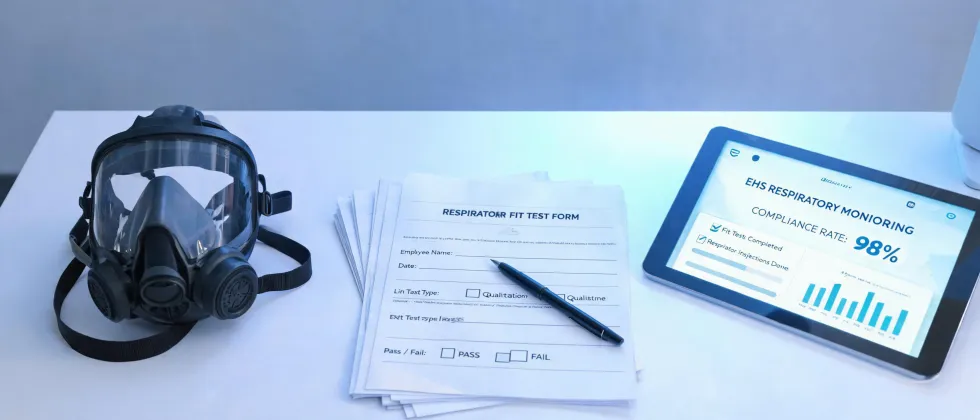
The 6200 is a legitimately good half mask. If you pair it with the right organic vapor cartridge, if it fits the wearer's face, and if the wearer does a seal check every time, it will handle a lot of solvent-based staining. But those 'ifs' do the heavy lifting. A half mask will not seal on a bearded face. Cartridges can expire or absorb contaminants in storage. And if you don't track service life, you are guessing on the one detail that determines whether the mask is protection or theater.
The TR-600 PAPR isn't simply 'more safety.' It's a different way to deliver protection. It pulls air through filters and pushes it into a facepiece or loose-fitting hood. Breathing resistance drops. Fatigue drops on long days. With a hood, a perfect face seal becomes less critical, which matters for workers who can't shave for religious, medical, or personal reasons. But the PAPR brings its own costs: batteries, cleaning, maintenance, training, and spare parts. Buy one without the support and it's an expensive fan on a belt.
I have mixed feelings about recommending PAPR systems. On one hand, they look like overkill for a two-person fence crew. On the other, I've watched companies spend more over two years on replacement cartridges, failed fit tests, and missed work than a PAPR would have cost in the first place.
Here is something the online product pages don't say: the $60 mask is the beginning of a recurring cost, not the end of one. The $1,200 PAPR can end up being the cheaper option if it means workers breathe easier and the equipment actually gets used.
Fall protection on Thursday
Two days later, a subcontractor sent me a text. 'Should I get a guardian fall protection harness?' He had found a full-body harness at a price he liked. Guardian makes good gear, so the answer should have been simple.
But his question skipped the part that matters. I asked him back: where is the anchor point? Is anything on that roof rated for the force of a fall? What is the clearance distance below the anchor? If someone falls and is hanging in the air, how do you get them down before suspension trauma becomes a factor?
Silence.
A harness is not fall protection. It is one component of a fall protection system. The system also includes an anchorage connector, a shock-absorbing lanyard or self-retracting lifeline, a properly rated anchor point, clearance calculations, and a rescue plan. Without those, a harness is confidence without protection. That confidence can be worse than no gear, because it changes the decisions people make at height.
CS gas vs pepper spray on Friday
The same week, a security account manager asked whether he should buy cs gas vs pepper spray for his guard team. He was comparing 'stopping power.' I don't claim to be a use-of-force expert. I also can't give legal advice about what is restricted in your state or province. What I can tell you, from a buying perspective, is that these are not interchangeable canisters.
CS gas is a tear agent. It causes tearing, coughing, and a panicky feeling. It can linger in enclosed spaces and affect the person who deployed it and any bystander. Pepper spray—OC—works on pain receptors. The effect is immediate and intense. But it creates contamination that has to be cleaned up, and a gust of wind can turn it back on the person holding the can.
The right answer does not come from comparing 'strength.' It comes from policy, training, local law, the environment where it will be used, and what happens after the use. That is true even for a $20 canister.
Three questions, one pattern
I sat down that weekend and looked back at the whole week. Three safety questions. None of them started with the hazard.
A mask without a fit test or cartridge plan. A harness without an anchor point. A chemical agent without a policy.
I don't think this happens because small buyers are careless. I think it happens because the market sells products by category, not by task. Product pages invite you to compare 6200 vs TR-600, or CS vs OC, or one harness brand against another. They don't ask the question that actually decides the outcome: what is the exposure, and what has to happen for this product to work when it counts?
What the pattern really costs
On a corporate budget, the cost shows up quietly at first. In 2023 I ran a full audit of our safety-related purchase orders over six years. I expected the big-ticket items—PAPR systems and fall protection hardware—to be the source of our budget overruns. They weren't. The overruns came from repeated small buys, rush orders, and stop-work events caused by equipment that was never integrated into a plan.
In Q3 2024, a subcontractor crew showed up at one of our job sites with their own lanyards and tried to tie off to a pipe that was never rated as an anchor point. Our safety lead stopped the job. Two days of schedule disappeared before the right system was installed. Nobody fell. The bill was roughly $4,200. A properly specified fall protection setup would have cost less than a quarter of that.
For my cousin, the math is harder to see. If he wears a respirator without a proper fit and spends a long afternoon spraying solvent-based stain, the first symptom might be a headache or nausea. He will likely call it a long day and go back the next morning. That mistake won't show up on a purchase order. It shows up in a doctor's office years later, or in a habit of cutting corners because no one ever explained what 'protection' actually requires.
The cheapest safety item is rarely the cheapest option once you include training, fit testing, maintenance, replacement, and the cost of a single failure.
How I make the call now
If you are responsible for any safety purchase, here is the short version of what I've learned.
- Describe the task before the product. 'Solvent-based stain, sprayed outdoors, about four hours at a time' is a better starting point than '3M respirator.' Name the hazard first. Then choose the tool.
- Find the standard, not just a brand. Respiratory protection should meet NIOSH requirements and, for workplace use, the fit testing and medical evaluation requirements in OSHA's Respiratory Protection standard. Fall protection components should be reviewed against ANSI/ASSP Z359 and, where relevant, OSHA 1926 Subpart M. Security products have their own legal and organizational constraints. Verify them.
- Calculate total cost, not sticker price. A $60 mask needs cartridges, seal checks, and replacement parts. A $1,200 PAPR needs batteries, maintenance, and training. A harness needs an anchor system and a rescue plan. A chemical agent needs policy and decontamination procedures. Add all of it before you compare.
- Take small orders seriously—and buy from people who do too. I started my career placing $200 orders. The suppliers who treated those orders as real business are the ones I later trusted with $20,000 orders. A distributor who won't spend 15 minutes on a $300 safety purchase is not a bargain at any price.
In my cousin's case, this process points to a defensible answer: a 6200 half mask with organic vapor cartridges is a legitimate choice for outdoor spraying a few hours per week, if he can pass a fit test and maintain the cartridges. If the work becomes daily, or if the wearer cannot get a tight seal, the PAPR becomes the cheaper option over time.
I am not pretending I have always done this well. I have bought a highly rated respirator after reading three reviews and skipped the fit test. I have approved a rush order because a previous decision had not been thought through. The habit I finally built is to start on paper, before a search engine or a vendor page gets a chance to set the agenda.
Maybe that sounds like overthinking. But consider my cousin's customer. A homeowner who searched 'fence staining near me' did not ask to become part of an industrial hygiene conversation. The stain still went into a sprayer, and the air did not care who was breathing it. Safety certification matters. Brand reputation matters. None of it matters if the product is not anchored to the actual hazard, the actual person, and the system that supports them.
Bottom line: safety gear is not a talisman. A respirator is only part of a respiratory protection program. A harness is only part of a fall protection system. A chemical agent is only part of a policy. Stop buying the object. Start buying the solution.