-
What's the Difference Between the 3M 2097 P100 Filter and Standard P100 Filters?
-
3M N100 vs P100: Which Filter Do We Actually Need?
-
Nitrile vs Latex Gloves: Which Should We Order?
-
How Often Should We Change the Fish Tank Filter Cartridge?
-
Vinyl Fence: What Should a Facility Buyer Know Before Installing One?
-
Can We Use One Type of 3M Filter for Multiple Jobs?
I've been managing supply purchasing for a 300-person manufacturing company for about five years now. Roughly $150K a year in orders across twelve vendors—safety equipment, office supplies, and more than a few head-scratchers. I report to both operations and finance, which means I get to balance "the crew needs it yesterday" against "is that in the budget?"
These are the six supply questions I get asked most often. And the answers usually come with a story.
What's the Difference Between the 3M 2097 P100 Filter and Standard P100 Filters?
I get this one at least monthly. The short version: the 3M 2097 P100 filter has a carbon layer that reduces nuisance-level organic vapors and acid gases, while the standard 2091 P100 filter is particulate-only. Same 99.97% particle filtration (that's the NIOSH P100 rating), different level of chemical protection.
I learned the difference the expensive way. In February 2024, I ordered 2091s for a warehouse painting project, assuming a P100 is a P100. Two hours in, the crew was calling about paint fumes. The 2091 stops particles—not vapors. The 2097, with its activated carbon layer, handles both.
Price-wise, 3M 2097 P100 filters run about $9-12 per pair from major safety distributors as of January 2025. The 2091 sits around $6-8 per pair. The $3-4 difference per filter ended up costing us a $76 rush order and a lost workday when we had to swap mid-project.
If your people work with paints, solvents, or chemical smells—or if you just don't want to carry two filter SKUs—get the 2097 and skip the 2091 altogether.
3M N100 vs P100: Which Filter Do We Actually Need?
The alphabet here confuses everyone, and I do not blame them. N100 and P100 have the same 99.97% particle capture efficiency. The letter is not a grade—it's an oil resistance rating.
N means not oil resistant. Fine for dust, mold, dry particulates, most grinding and sanding work.
P means oil proof. Designed for environments with oil-based aerosols—cutting fluids, lubricants, hydraulic oil mist.
For most facilities, N100 is adequate. But most facilities don't know for certain whether oil aerosols will show up on any given job. That's why we standardized on P100 during our 2023 vendor consolidation. It cut our filter inventory from four SKUs to two.
Pricing: a 3M N100 filter (like the 8293) runs about $7-9 per unit. P100 filters in pairs—like the 2091 or 2097—cost roughly $6-12 per pair. The pair math makes P100 the better deal in most cases.
My rule: if you're kinda unsure about oil exposure, go P100. The price difference is negligible. The cost of guessing wrong is not—it's a respirator that doesn't protect your worker.
Nitrile vs Latex Gloves: Which Should We Order?
Nitrile. Full stop—for most workplaces.
The 'latex is better' thinking comes from an era when nitrile gloves were stiff, thick, and uncomfortable. That changed years ago. Modern nitrile formulations stretch almost as well, and most workers genuinely can't tell the difference on the hand.
Latex gloves are still cheaper, more elastic, and biodegradable. To be fair, they win for applications requiring maximum tactile precision at the lowest cost. But latex has one dealbreaker in a workplace setting: the proteins in natural rubber latex cause allergic reactions—and these can develop slowly through repeated exposure. You don't want to be the buyer who introduced an allergen to your cleaning crew to save two dollars a box.
Cost as of January 2025: nitrile exam gloves run roughly $10-14 per box of 100 from major suppliers. Latex runs $8-11 per box. That's a $2-3 gap per box—maybe $1,200 a year for our facility. Worker's comp claims from contact dermatitis cost many times that.
In my experience, nitrile also handles chemicals better: ketones, diluted acids, and most solvents won't break it down as quickly as latex. For cleaning, painting, maintenance, and first aid, nitrile is the answer.
How Often Should We Change the Fish Tank Filter Cartridge?
You'd be surprised how often this comes up. We've got a 75-gallon aquarium in our reception area, and I've been managing it since 2021. The generic answer: every 3-4 weeks. The honest answer: it depends, and over-changing is a real problem.
Here's what I got wrong. In 2023, I put the cartridge on a strict two-week replacement schedule, thinking fresher is always better. The tank clouded up within days after every change. I assumed the cartridge was bad. The pet supply vendor I buy from finally explained: the beneficial bacteria that break down fish waste live on the filter media. Replacing the cartridge too often nukes your biological filtration. The cloudy water was the tank re-cycling.
What works now: I remove the cartridge once a week and rinse it in a bucket of tank water—never tap water, because chlorine kills the bacteria. I replace the cartridge every 4-6 weeks, or sooner only when the water flow drops noticeably.
On product choice: we use 3M Filtrete-brand cartridges because they're what our distributor stocks consistently. Whatever you buy, check that it matches your filter manufacturer's specs—a generic cartridge can starve the pump in some tanks.
Vinyl Fence: What Should a Facility Buyer Know Before Installing One?
When our company fenced off the equipment yard in 2021, I spent an unhealthy amount of time researching vinyl fencing. Here's what actually mattered.
Wall thickness is the spec to check first. Residential-grade vinyl fence is typically 0.040-inch thick. Commercial-grade starts at 0.050-inch. Thicker walls handle impacts, wind loads, and thermal movement better. We went with 0.050-inch, and it's survived two Midwest windstorms and a forklift tap that would've cracked the thinner stuff.
Installation quality matters more than the fence brand. A good installer digs the posts below the frost line—at least 2 feet in our region—sets them in well-cured concrete, and leaves expansion gaps on long runs. Get that wrong and your fence will sag or crack in the first winter no matter how much you paid for the materials.
Budget: commercial-grade vinyl fence runs roughly $25-45 per linear foot installed, based on quotes from three Midwest installers I gathered in February 2025. Gates add $400-800 depending on size and whether you automate them.
One thing nobody tells you: vinyl gets brittle in extreme cold. I've seen a post crack at -10°F. For small repairs, 3M's outdoor heavy-duty adhesive sealant works well on PVC, and 3M VHB tape is handy for attaching gate hardware without drilling extra holes.
Can We Use One Type of 3M Filter for Multiple Jobs?
For mixed work—sanding, painting, solvent cleaning—the 3M 2097 P100 is the closest thing to a one-and-done filter. It captures particulates at P100 efficiency and knocks down nuisance-level organic vapors via that carbon layer I mentioned earlier. That's why it's our default.
But don't oversell it. The carbon layer in the 2097 is designed for nuisance-level exposure, not continuous heavy solvent work. If someone is spray painting all day or working in confined spaces with solvent fumes, they probably need a 3M 6000-series gas/vapor cartridge combined with a P100 particulate filter—or a powered air purifying respirator like the 3M Versaflo line. Those are real chemical protection, not nuisance reduction.
Also: filters expire. A sealed 3M P100 filter is good through the date punched on the package. Once it's open, replace it when you notice breathing resistance, visible damage, or a smell breakthrough. I keep two spare pairs in stock and rotate them quarterly so nothing sits past its date.
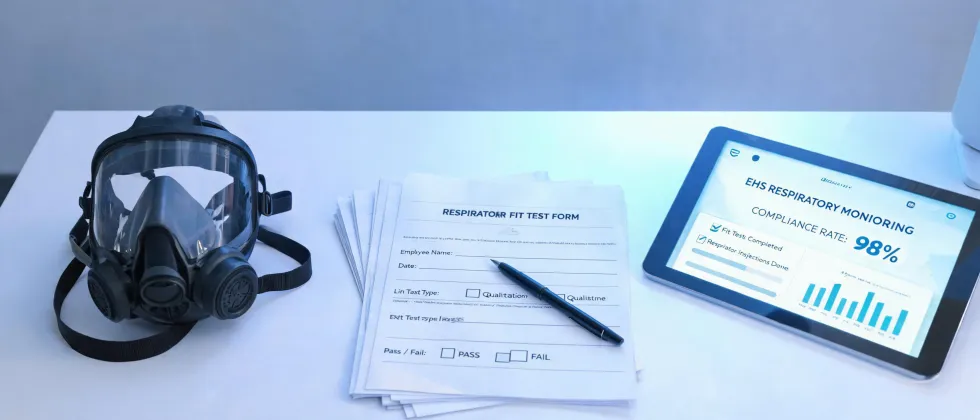
And if you're outfitting a team, remember that one size doesn't fit all. Under OSHA's respiratory protection standard (29 CFR 1910.134), users need fit testing before wearing a tight-fitting respirator in the workplace. That's a separate process from buying filters, but it's a step you can't skip.