-
Scenario 1: Head Protection — Safety Helmet vs Hard Hat
-
Scenario 2: Breathing Protection — Choosing 3M Respirators That Match the Hazard
-
Scenario 3: Night Visibility — 3M Reflective Material and the Class Question
-
Scenario 4: Foot Protection — Black Work Boots That Actually Protect
-
How Do You Know Which Scenario Is Yours?
There's no single right answer to the safety helmet vs hard hat question. The right answer depends on what your crew does, where they work, and what could fall, splash, or fly at them. The same logic applies to 3M respirators, 3M reflective material, and black work boots. Four different problems, one vague phrase: "safety gear." Each one needs a different decision process.
I've handled safety equipment orders for eight years — first as a junior buyer, now as the person who maintains our pre-order checklist. In that time, I've made and documented 12 significant procurement mistakes, totaling roughly $18,500 in wasted budget. The four scenarios below — head protection, breathing protection, night visibility, and foot protection — are where I've seen the most money go up in smoke, by me and by people who asked for my advice.
Actually, one quick story before we get into it. I once told a client, "We handle all your safety equipment needs." He heard, "Any product related to safety, including pet containment." A week later, his assistant asked if the 3M shipment would include the invisible fence for cats they'd seen mentioned on our website. We don't sell those. But the misunderstanding stuck with me, because it's the same failure I've made with serious equipment: both sides said "safety gear" and meant completely different products. The expensive mistakes below all started that way.
Scenario 1: Head Protection — Safety Helmet vs Hard Hat
The question everyone asks is, "Which is better?" The question they should ask is, "What type of impact is my crew exposed to?"
A hard hat is built for one primary job: protecting the top of the head from falling objects. It meets ANSI/ISEA Z89.1 Type I requirements, and it's inexpensive. Most construction sites use these for a reason.
A safety helmet — like the 3M H-800 series — is a different category. It's available in Type I and Type II configurations, meaning it can also handle side impacts when you choose the right model. It has a chin strap, a lower profile, and accessory mounts for face shields, earmuffs, or headlamps. It's built for people who lean back, look up, and work at height.
My 2019 mistake: I ordered 40 hard hats for a structural steel crew. The foreman called on day one: "These fall off when the guys tilt their heads." They needed chin straps, which a standard hard hat doesn't have. We exchanged all 40 for safety helmets. Restocking fee plus expedited shipping: about $1,180.
Now for the counterintuitive part: a safety helmet is not always the right upgrade. On a hot outdoor site, a heavier helmet with a chin strap gets taken off more often when a supervisor isn't looking. A basic hard hat that stays on is safer than a better helmet hanging off a hook. Choose based on posture and fall risk, not on which option sounds more modern.
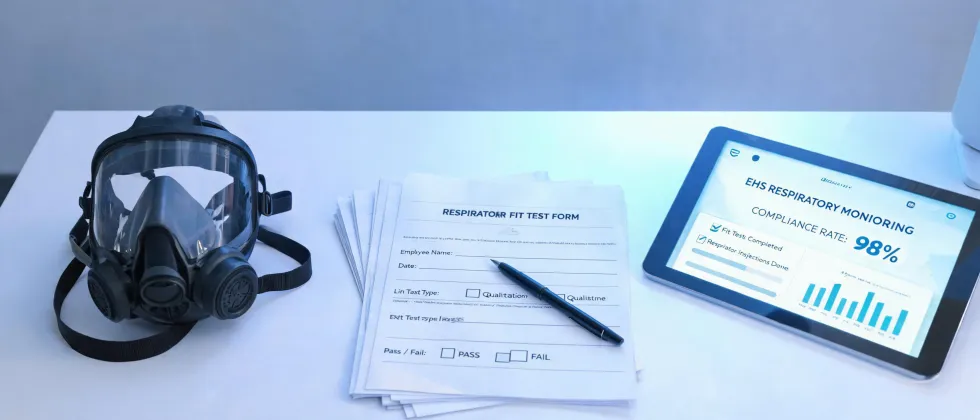
Scenario 2: Breathing Protection — Choosing 3M Respirators That Match the Hazard
Respirators are the category where I see the most confusion, from clients and, in 2021, from myself.
A contractor asked for "3M respirators" for a crew spraying a solvent-based coating. I sent N95 filtering facepieces, because when someone says "mask," that's what comes to mind. The N95 is a NIOSH-approved particulate respirator (under 42 CFR Part 84), and it does something real: it filters 95% of airborne particulates. But it does nothing against organic solvent vapors. The crew stood down for three days while we overnighted half-face respirators with organic vapor cartridges. The error cost about $2,800 including return shipping and the expedite premium.
The blind spot I keep seeing: buyers focus on brand and comfort, and completely miss the contaminant. A 3M respirator's protection depends on which cartridge or filter is attached, not on the name printed on the front.
Here's the decision guide I actually use now:
- Particulates only — concrete dust, grinding, pollen, mold. An N95 disposable like the 3M 8210 is usually sufficient, assuming you fit-test it.
- Vapors, gases, or fumes — solvents, paints, acids. You need a cartridge respirator like the 3M 6000 series half-face, with cartridges selected for the specific chemical.
- Full-shift wear or high hazard — consider a Powered Air Purifying Respirator (PAPR) like the 3M Versaflo system. It costs $1,000-$1,500 per unit plus training and battery management. But workers keep it on for eight hours. A mask that nobody wears is not cheaper than a PAPR that everyone wears.
If you haven't identified the contaminant, you're not ready to order anything. That's not a problem with the supplier. That's a problem with the information.
Scenario 3: Night Visibility — 3M Reflective Material and the Class Question
In 2023, I bought high-visibility vests for a road maintenance crew. I chose by price. The vests looked bright in the listing photos and passed the office "looks fine" test. A state inspector flagged them on the first site visit: Class 2 vests, but the job required Class 3.
ANSI/ISEA 107 sorts high-visibility clothing into classes based on how much background fabric and reflective tape are on the garment. Class 2 suits parking lots and local roads where traffic stays under 50 mph. Class 3 carries roughly double the reflective striping area and is what highway work typically demands.
Most quality high-vis gear uses 3M reflective material — specifically 3M Scotchlite. The same material is sold as reflective tape for trailers, signage, barricades, and vehicle markings. If you're applying it to a trailer for DOT compliance, the rule is the same: use the grade and pattern the regulation requires, not whatever looks brightest in a photo.
The question nobody asks at the beginning is, "Where exactly will this be worn and how fast does traffic move there?" Fluorescent fabric handles daytime; reflective material handles night. You need both. The class you need is a legal requirement, not a style preference. My $600 replacement order taught me that the inspector is not the place to discover your class was wrong.
Scenario 4: Foot Protection — Black Work Boots That Actually Protect
3M doesn't make boots (as far as I know — I check every year because people ask). But boots belong in this conversation because I've made that mistake too.
In 2022, a plant manager asked me to source black work boots for a machining team. I picked a pair with the right color, the right price, and the bare minimum safety toe rating. What I did not check was slip resistance. Six weeks later, a machinist stepped on an oily patch and went down. He was off work for six days. That conversation with the plant manager is one I'd rather not repeat.
If you're buying black work boots for a crew, check these four things:
- ASTM F2413-18 — the safety toe standard. Look for I/75 (impact) and C/75 (compression) marking. If it's not in the boot, it's not rated.
- Slip resistance — don't assume a chunky outsole means grip. Ask for the test standard, often ASTM F2913.
- Toe material — composite or alloy toe if workers pass through metal detectors. Steel toe triggers every security checkpoint.
- Fit — boots that hurt end up in lockers. A $200 boot nobody wears is not safer than a $90 boot that fits.
The color part is a distraction. Black is often a company appearance requirement, but it has nothing to do with protection. Judge the boot by its label, not its color.
How Do You Know Which Scenario Is Yours?
Most teams fit more than one scenario. A highway crew needs head protection, high-visibility clothing, and probably boots. A lab might only need respiratory protection. The point of separating them is to stop buying the all-in-one bundle that doesn't fit any of them.
Here's the three-step check I run before every order now:
- Identify the actual hazard. Walk the job site, not the supplier website. Write down what could hurt someone. That list determines which scenario (or scenarios) you're in.
- Check what the standard says. OSHA 29 CFR 1910.134 for respirators, 29 CFR 1926.100 for head protection on construction sites, ANSI/ISEA 107 for high-vis, ASTM F2413 for footwear. The regulation usually settles the safety helmet vs hard hat question for you.
- Talk to the person wearing it. The last time I skipped this step, I bought 60 facepieces that fogged up every pair of safety glasses on the crew. A two-minute conversation would have caught it.
And one budget lesson that applies to all four scenarios: ask "what's not included?" before you ask "what's the price?" I've compared quotes on 3M respirators, picked the lowest per-unit number, and later discovered that shipping, handling, and restocking fees made it the most expensive total. The supplier who lists every fee in the quote upfront looks more expensive at first glance. In my experience, they're usually the honest deal. Total cost, not unit price, is the number that matters.
And if you landed here looking for an invisible fence for cats — different industry, sorry. But you're thinking about safety in the right way. Know the actual problem before you buy the solution. That's the whole article in one sentence.
