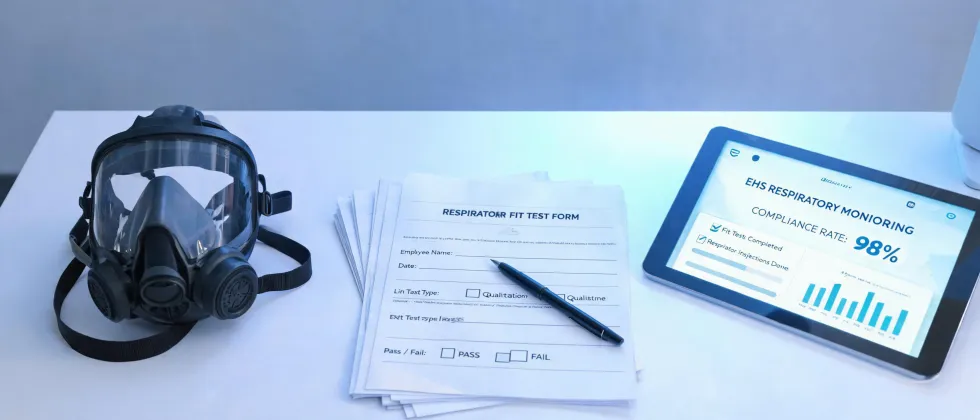
If you're responsible for specifying or accepting 3M safety equipment at a construction site, manufacturing plant, or farm operation, this checklist is for you. In my role as quality compliance manager, I review PPE orders before they reach the floor. Roughly 300 line items per quarter, and I've flagged about 12% of first deliveries this year for spec mismatches. Three questions come up more than any others: filter replacement timing, glasses versus goggles, and reflective tape. Here's how I walk our team through each decision.
Step 1: How Long Do 3M Respirator Filters Last?
The honest answer: there's no fixed number. Anyone who gives you a universal “replace after 30 days” rule is simplifying past the point of usefulness. Service life depends on the filter type, the contaminant concentration, how hard the wearer is breathing, and humidity. That said, you can make a practical call with three pieces of information.
Particulate filters on reusable masks
For particulate filters like the 3M 2091 or 7093 P100 models, replace them when they're visibly dirty, damaged, or when the wearer notices increased breathing resistance. In our facility, crews on 8-hour shifts swap particulate filters weekly. That's an operational convenience, not a 3M mandate. Some lighter-duty environments get three weeks, some heavy grinding areas need twice a week.
Chemical cartridges
This is where precision matters. For chemical cartridges like the 3M 6001 organic vapor cartridge, the replacement interval should be calculated, not guessed. 3M's service life software accounts for contaminant concentration, temperature, humidity, and workload. In our solvent operations, that typically works out to a 14-day change-out based on air monitoring data. But that's site-specific.
The mistake that catches people: relying on smell or taste to know when the cartridge is spent. By the time you smell breakthrough, the cartridge has been saturated for a while. You've already been exposed. For contaminants with poor warning properties, this is a real hazard, not a minor inconvenience. This is the most common issue I find during field audits, and it's easy to fix with a written schedule.
Under the OSHA respiratory protection standard (29 CFR 1910.134), you're required to have a documented change-out schedule for chemical cartridges. If you don't have one, you're out of compliance even if your filters are fine.
Unopened particulate filters typically have a shelf life of about 5 years from the manufacturing date (as of January 2025). Mark the date on the package when you break the seal. That small habit saves a lot of guesswork later.
Step 2: Safety Glasses vs Safety Goggles: How to Choose
The way I see it, the best eye protection is the one your workers will actually wear. But will-they-wear-it only matters if it matches the hazard first. Here's how to think about it.
When safety glasses are enough
Safety glasses like the 3M SecureFit series are rated for impact protection under ANSI Z87.1. They handle flying debris, dust, and incidental contact. For general construction, light assembly, and outdoor work, glasses are the practical choice. They're lighter, fog less easily, and give a wider field of view.
When goggles are non-negotiable
Goggles are required when there's splash, fine airborne dust, chemical mist, or anything that can reach the eyes from the side. The sealed frame makes the difference. In our Q1 2024 audit, 40% of the grinding crew were wearing safety glasses instead of goggles. Grinding produces fine particles that deflect off the lens edges, and glasses leave the orbital area exposed. That's exactly the scenario where goggles are required.
What most people don't realize is that the Z87.1 stamp on the frame doesn't guarantee a good fit. I've seen workers wearing glasses where the side shields pulled away from their temples, especially in hot conditions. If the frame flexes when you press gently on the center, it's not going to stay in place during actual work.
From my perspective, the upgrade to vented anti-fog goggles is worth it. We made that switch for our grinding team in late 2024, and usage rates went from roughly 60% to 95%. The $2–4 extra per unit is what actually gets compliance on faces rather than in toolboxes.
Step 3: 3M Black Reflective Tape for Fences and Equipment
Quick clarification before we dig in: 3M doesn't make wireless pet fences. If you're searching for a “pet safe wireless fence,” that's a separate product category and a different buying decision. What 3M does make, and what serves a similar visibility goal, is black reflective tape, specifically the 3M Scotchlite 680 or 870 series.
Reflective tape is not just for tractor trailers and highway signs. On farms, ranches, and residential properties, 3M black reflective tape is a practical way to make fence wires visible. A dark fence line disappears at dusk, and that's exactly when people and animals are moving around. We started using it after a contractor's horse ran into a wire fence at sunset; the tape costs about $15 a roll, which is a lot less than the vet bill.
Application is simple, but people get it wrong. Here's the sequence:
- Clean the surface. Wipe fence wire or posts with a degreaser or isopropyl alcohol. Dust and oxidation cause tape to peel within weeks.
- Let it dry completely. Surface temperature needs to be above 50°F (10°C) for the adhesive to bond. Applying tape on a cold February morning is a waste of tape.
- Apply with firm, even pressure. Peel and press as you go, ideally with a roller. You want full contact with the wire, not a strip that bridges the gaps.
- Overlap at corners and terminal ends. Leave at least a 1-inch overlap so there's no edge catching wind or vegetation.
- Check after 24 hours. If the tape lifted anywhere, the surface wasn't clean enough or the temperature was too low. Re-clean and reapply those spots.
For pet owners who use an invisible wireless fence, adding reflective tape on visible boundary markers gives the animal a visual cue to match the electronic correction. It won't contain a pet on its own, and it doesn't replace the wireless fence system. But it does reduce startled reactions at the boundary, and it makes the fence line visible to people walking through the yard at night.
One honest limitation: black reflective tape is durable but not bulletproof. In high-traffic areas or harsh UV exposure, it will degrade. Check it each season and reapply as needed. Faded tape is just dark tape.
Common Mistakes and Final Notes
Three things I'd flag from actual site experiences:
1. Avoid marketplace listings for 3M filters. We saved about $3 per filter on a third-party listing once. The batch failed pressure drop checks in under an hour of testing, and we lost two days re-testing and reordering. Buy from authorized 3M distributors. The savings aren't worth the risk.
2. Don't store filters in vehicles. Heat and UV degrade filter media. I saw a crew keep P100 filters in a pickup bed toolbox through an Arizona summer. Nothing failed catastrophically, but the media smelled wrong and breathing resistance felt elevated. Filters belong indoors, in sealed bags, at room temperature.
3. Fogged goggles end up on foreheads. If you buy cheap goggles without anti-fog treatment, compliance is theoretical. The $2–4 upgrade is the difference between workers wearing them in humid conditions and a row of contractors with goggles pushed up on their hats.
A last note on scope: this checklist covers common workplace scenarios. If you're dealing with IDLH (immediately dangerous to life or health) atmospheres, confined spaces, or unknown chemical exposures, this guide is not your procedure. Bring in an industrial hygienist and follow your site-specific written program.
As of January 2025, the NIOSH Certified Equipment List and 3M's technical bulletins are the most current sources for filter service life and component compatibility. Check those before your next order, especially if conditions at your site have changed since the last evaluation.
