I've been managing purchasing for our facility since 2020. We're a mid-size company with about 200 people across two buildings: a light manufacturing floor, an office, and a kitchen that serves lunch. When I took over the safety supply orders, I figured it'd be simple. Reorder what the previous person ordered, restock the bins, done. Honestly? I was naive.
The most frustrating part of this job is that the same questions come back over and over, and the answer keeps changing depending on who's asking. "What respirator should we use?" Depends. "Are latex gloves food safe for the kitchen?" Depends. "Do we need hard hat sun shades?" Depends. You'd think at least one of these would have a universal answer. It doesn't.
So here's how I actually decide. Find your situation below and save yourself the trial-and-error.
Respirators: 3M N95 Masks or the 3M 6300 Respirator?
This is the biggest safety supply line in our budget, and the question I get most often from team leads. The honest answer: the 3M N95 mask and the 3M 6300 respirator solve different problems. The choice comes down to what your people are exposed to and how often.
Scenario A: Occasional Particle Exposure → 3M N95 Masks
If your team is doing drywall repair, sweeping out a dusty storage area, or hosting a visitor who needs to walk the production floor, a disposable 3M N95 mask is the right call. It's NIOSH-approved for particulate filtering, and it's basically as simple as respiratory protection gets. Wear it, toss it, grab a new one.
We keep a box of the 3M 8210 N95 masks at the front desk and another in the maintenance closet. Most weeks we don't crack it open. But when someone needs to walk through a dusty area without chewing on sawdust all day, it saves us. No fitting appointment, no cartridges to track, no cleaning.
(One thing we learned the hard way: even disposables need a fit check. A mask that doesn't seal around the nose is theater, not protection.)
That said, disposable N95s have a real limit: they do nothing for chemical vapors or gases. And if you're wearing them daily, the cost stacks up fast.
Scenario B: Chemical Vapors or Regular Heavy Use → the 3M 6300 Respirator
The 3M 6300 is a half-mask, reusable respirator with replaceable cartridges. It's a completely different tool. Instead of just catching particles, you match the cartridge to the chemical. For organic vapors, it's the 6001 cartridge. For particles plus vapors, it's the 60921. The SDS for the specific solvent will tell you which one you need — or better, ask your EHS person.
We moved our maintenance team to the 6300 in 2023. The tipping point? A few weeks of headaches during a painting project, and an EHS consultant who pointed at the SDS and said, "this calls for organic vapor protection." Our N95s weren't doing anything against the fumes. Honestly, I should've caught it sooner. It was right there in the safety data sheet.
The upfront cost was about $35–45 per mask based on my records from our March 2023 order — verify current pricing with your distributor. The cartridges last a long time if your crew seals them in a bag when not in use. Compared to buying disposables every week, the 6300 pays for itself within a couple of months for regular users.
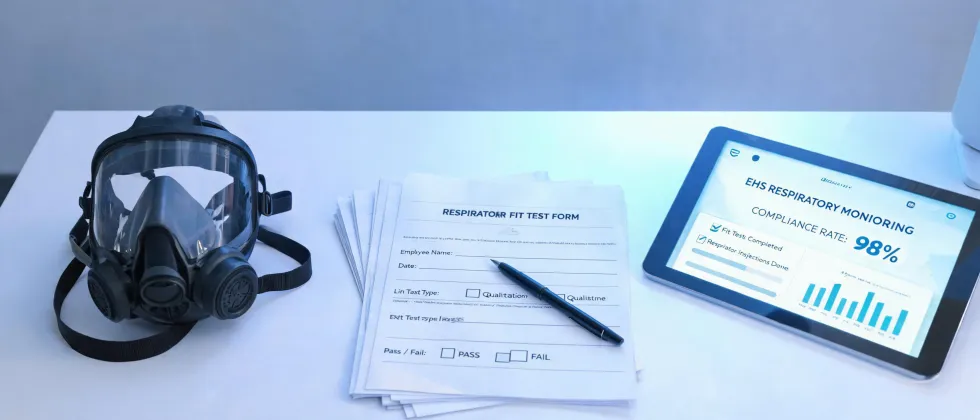
The catch: the 6300 requires a proper fit test, and users need to do a user seal check each time they put it on. OSHA's respiratory standard (29 CFR 1910.134) is not shy about this. We hired a local vendor to fit-test our team of 12. It took less than an hour, and it cost about $200. That's an easy expense to justify.
How to Choose
- Particles only, occasional use → 3M N95 disposable masks.
- Vapors or gases, or more than a few hours of use per week → 3M 6300 with the right cartridges.
- Not sure? Start with the SDS. If it still isn't clear, bring in a safety professional rather than guessing.
Hard Hat Sun Shades: Do You Actually Need Them?
I got pushback from our facility manager on this one. "OSHA doesn't require them," he said. Fair, but a lot of things are worth buying without OSHA mandating them.
The 3M hard hat sun shade attaches to the back of a standard hard hat in a few seconds. It covers the back of the neck — the exact spot that gets roasted when you're working outside facing away from the sun. We have crew members standing outside for six or more hours a day during summer production, so we bought 40 shades in June 2024. The feedback came back fast: "Why didn't we have these last year?" (I still feel bad. They'd asked. I just hadn't pushed the budget.)
But here's the counter-scenario: if your team is mostly indoors and their only sun exposure is the walk from the parking lot, skip the sun shade. At that point it's a luxury, not a safety item. Spend that money on replacement lenses for safety glasses or extra hearing protection.
Privacy Screen Fences: When the Right Move Is "We Don't Do That"
Our operations lead asked me to look into a privacy screen fence for the back loading area. The goal was to block the street view of the dumpster and the loading dock — a legitimate security and appearance issue.
I'll be straight with you: this isn't a product category our main safety supplier leads with. Privacy fence screening isn't 3M's lane, and that's okay. A vendor who claims to be the best at everything is a red flag. The ones who say "this isn't our strength, but here's who does it better" earn my trust for everything else. I'd rather hear that than get a generic product that's out of their depth.
What we did instead: bought a vinyl-coated privacy screen from a local supplier, designed to attach to chain-link fencing. It's been through a Carolina summer and winter so far, and it's holding up fine. Look for one with UV protection and decent wind resistance, and check your local zoning codes before you buy — fence height and material restrictions apply in most municipalities. If the privacy need ever involves windows and glass, that's where architectural window films genuinely shine. But for fence screens? Find a specialist.
Are Latex Gloves Food Safe? The Short Answer and the Fine Print
Our kitchen coordinator asked me this last year when we were ordering gloves for food prep. I assumed the answer was "yes, obviously." Turns out it's not that simple.
The quick answer: yes, latex gloves can be food safe. The FDA Food Code permits powder-free latex gloves for food contact, and 21 CFR Part 895 restricts powdered gloves. If a box says "food grade" or "food safe," it meets federal requirements for food contact.
But here's the fine print: many state and local health codes restrict or ban latex gloves in food service, mostly because of allergic reactions among customers and staff. California and several other states have moved in that direction. Even if latex is technically compliant in your area, why take the risk in front of a customer or a worker who might react?
We switched our kitchen to powder-free nitrile gloves. Nitrile eliminates the allergy concern entirely, holds up well for food prep, and with pandemic shortages long over, prices have settled back to normal ranges (based on our late 2024 supplier quotes — verify current rates). If you're ordering for a food service operation, check your state's food code before choosing. The answer can genuinely vary by county.
So How Do I Actually Decide?
I run every safety supply request through three questions:
- How often is this actually used? Daily use justifies durable, reusable equipment like the 6300. Once a month doesn't. It's that simple.
- What does the safety data sheet say? The SDS tells you the specific protection you need. Read it before you buy anything.
- What do local rules require? Food codes, zoning height limits, and OSHA standards all shape what you should buy.
The point isn't to buy the cheapest product. It's to buy the right product for your situation. This approach has worked well for us, but our context is specific: a mid-size B2B company with predictable ordering patterns. If you're a seasonal business with demand spikes, or a multi-site operation with varying exposures, the calculus might be different. That's okay. Find your scenario, then buy for that scenario.
