9:40 on a Tuesday in March
Danny walked into my office at 9:40 on a Tuesday in March 2023. The saws were still running in the shop behind him. He sat down slowly, put both hands on the edge of my desk, and said, "I think I need to go to urgent care."
There was no blood. No crushed finger. He was just trying to see straight after two hours of spraying stain on cedar fence panels while wearing the cheapest respirator I could find in bulk.
I'd love to say that was the moment everything changed. It wasn't. It was the moment I started doing the math.
Meet the Cost Controller
For context: I'm the guy who handles procurement at a 35-person wood fence company outside Columbus, Ohio. We build and repair wood fences—cedar, pine, pressure-treated. That means our crew deals with wood dust, solvent vapors, saw noise at 100+ decibels, and more splinters and nail scratches than I ever want to count.
I've managed our safety budget for six years now. At its peak, that budget was $38,000 a year. I've negotiated with dozens of vendors, tracked every invoice in a spreadsheet, and built my own cost calculator after getting burned on hidden fees twice. I'm the guy who asks whether the premium option is actually worth it.
And for six years, my answer was usually "no."
The Logic of Buying Cheap
To be fair to my past self, the logic wasn't crazy. We're a small operation. Every dollar I saved on disposables went somewhere else—better saw blades, a new compressor, a raise for the crew. When I compared a $6.50 disposable respirator to a professional half-mask with replaceable cartridges, I saw the word "respirator" on both boxes and called it a day.
I was wrong. Let me be specific about why.
The cheap masks weren't designed for solvent vapors. They were particle masks. And they were uncomfortable, which meant guys pulled them off the second I walked away. The same thing happened with the foam earplugs I bought in mega packs: I'd find them on the floor, in the trucks, hanging around necks—anywhere except in ears. I ignored it because the spreadsheet looked good. The unit price was low. That's what I was managing.
Look, it wasn't one big failure. It was a thousand small ones. A strap snapping mid-project. A worker coming in with a headache every other Friday. A batch of cheap gloves that fell apart after two washes. Each one felt minor. I kept telling myself that PPE is PPE, and the crew knows what they're doing.
An $18,000 Assumption
Here's what actually happened that Tuesday. Danny and two installers were applying a semi-transparent stain to a run of cedar panels. Ninety minutes in, Danny's head started pounding. By the time he reached my office, he was nauseous. The respirator I'd handed him didn't stop organic vapors. Not even close.
The urgent care visit cost $260. Danny lost two days of work. Two other guys lost half a day re-spraying his sections. We paid a $350 late fee because the project missed its deadline. All from a respirator that cost $6.50. Total tab for that single morning: roughly $2,000.
Then I did something I should have done years earlier. I pulled the whole year's records. In 2023, our PPE-related incident costs—medical visits, lost time, re-work, late fees, rush shipping—added up to about $18,000. I was so proud of my low unit prices that I'd never noticed the line items I was creating on the other side of the ledger.
The hardest part to swallow was that $18,000 was probably an undercount. I hadn't tracked the small stuff—the 20 minutes here, the 30 minutes there, the guy who went home a little more tired than he should've been. Those costs don't show up on invoices. They show up on the P&L as "somehow, our margins are thin."
The Sports Drink Moment
That same week, I watched Danny lean against his truck and drink a BodyArmor. One of the installers asked, "Is BodyArmor zero sugar good for you, or is it just marketing?" Danny shrugged. I shrugged.
It hit me that we'll debate a sports drink for ten minutes, but we'll put a questionable piece of plastic over a worker's face and never ask a single question about what it's actually supposed to stop. I stopped being quite so confident in my spreadsheet after that.
What the Research Showed
I spent a few weekends reading what professional crews use. Three things stood out, and all three happened to be 3M.
The 3M 6300 Respirator
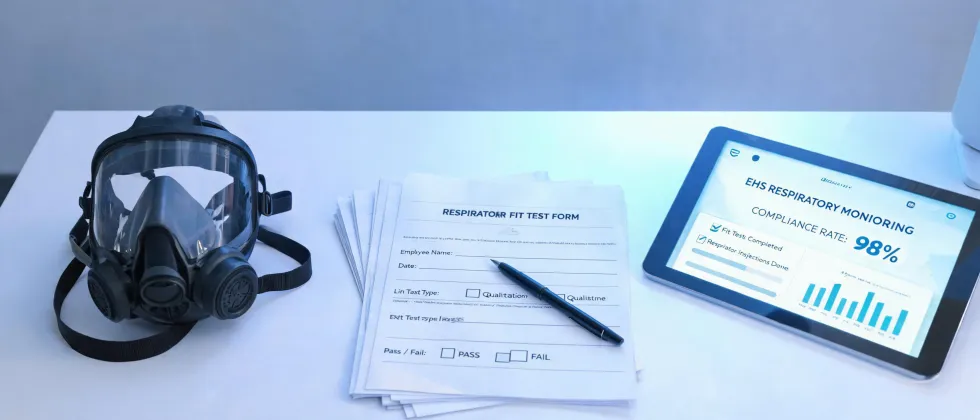
The 3M 6300 respirator is the half-mask you see on chemical plants, painting crews, and just about any professional who has to breathe near solvents. I'd skipped past it in catalogs for years because the list price was four or five times what I paid for disposables.
Here's the thing about total cost: the 6300 is reusable. You replace the cartridges instead of throwing away the whole mask. The facepiece is silicone, so it's still comfortable at hour six. It takes the organic vapor cartridges we actually need for stains. And it's NIOSH-approved, which is the standard that actually means something.
One 6300 with a fresh set of cartridges outperformed a stack of disposables in the first year. The disposables would've filled a dumpster. Per OSHA 29 CFR 1910.134, the respirator has to match the specific hazard—a particle mask doesn't meet that for solvent vapors. I didn't read the standard until I needed it. That's on me.
We also didn't have a written hazard assessment, which is exactly the kind of paperwork that would've caught this problem before Danny ever walked into my office. We have one now.
Before anyone orders one: tight-fitting respirators require a fit test before first use. That's a real OSHA requirement, not a suggestion. Budget for it.
The 3M Bluetooth Earmuffs
The Bluetooth earmuffs were the hardest for me to approve. I saw the price and thought, "absolutely not." But our crew had been wearing earbuds under regular muffs for years. I watched it happen constantly: music in, hearing protection out.
The 3M Bluetooth earmuffs changed the equation because they made wearing hearing protection easy. They have real NRR protection—24 to 25 dB depending on the model—with audio built in. They're around $80 to $150 a pair depending on the model and retailer, which made me wince. Then I looked at what lifetime hearing damage actually costs a person and stopped wincing.
Hearing protection compliance on the saw line went from maybe 40% to over 90% within a month. I don't love that they listen to music on the job. I love the alternative a lot less.
Kevlar Gloves
Kevlar gloves almost didn't make it into the order. I'd always thought of them as something for metal stamping plants, not fence crews. Then I looked at our injury log. Cuts and punctures from rough-cut lumber and old fence boards were our most common shop injury. We were treating them like an unavoidable cost of doing business.
We added cut-resistant Kevlar gloves to the crew's glove box. The injuries didn't disappear, but they stopped dominating our incident list. The gloves cost a few dollars more per pair. The ER co-pays cost a lot more than that.
The Numbers That Matter
Here's the summary, because this is a cost story, not a feel-good story. In 2023, we spent about $22,000 on PPE and about $18,000 on the consequences of that PPE not being good enough. Total: roughly $40,000.
Last year, after the switch to 3M, we spent about $31,000 on better PPE and about $4,100 on consequences. Total: roughly $35,100. The equipment line went up $9,000. The incident line went down about $13,900. Net result: roughly $4,900 back in the budget, plus fewer trips to urgent care.
I should add the obvious caveat: prices change, and this was accurate as of Q4 2024. Verify current pricing and cartridge specs before you budget. I'm not promising anyone else's numbers will match ours. But the logic isn't complicated: cheap protection that doesn't get worn isn't protection at all.
What I'd Tell Another Small Shop
If you run a small shop, don't convince yourself that professional-grade safety equipment is only for big companies. I almost made that mistake. I assumed a 35-person wood fence company wouldn't be taken seriously. That assumption was wrong too. The same 3M 6300 respirator that protects a refinery worker is the one we use. Nobody checked our revenue before selling us a cartridge.
The vendors who took our small orders seriously in the beginning are the ones we still spend real money with today. Small accounts grow. Good suppliers know it.
Price is what you pay. Total cost is what you actually lose.
I still track every invoice. I still keep the spreadsheet. I just measure the right things now.
