- The Hype Around "Fresh Air Through a Hose" Misses the Point
-
The Hidden Trap in "Affordable" Alternatives
-
Comfort Drives Compliance, and Compliance Drives Cost
-
Heat Wave Safety Glasses & Other Things People Forget
-
What About the "Water Filter Cartridge" Question?
-
Is 3M Worth the Premium? Usually—For a Specific Reason
-
The "One-Stop Shop" Trap
-
My Rebuttal to the "Just Buy the Cheapest Approved" School
-
Practical Advice: Start With the Work Task, Not the Product KPI
-
So—Would I Buy 3M Again?
Let me state this clearly: the 3M half facepiece reusable respirator is the backbone of most industrial PPE programs for a reason. But if you think buying one—or a box of 3M respirator cartridges—solves your respiratory protection program, you're wrong. And that's not a knock on 3M. It's a knock on how we talk about equipment instead of systems.
I've been managing procurement for a 340-person manufacturing operation for over six years. My annual PPE budget runs around $180,000. I've negotiated with 12+ vendors, audited our 2023 spending line by line, and built a cost calculator after getting burned on hidden fees twice. So when I say the equipment is the easy part, I mean it.
So what actually matters? Let me walk you through what I've learned—including the stuff that cost me real money to figure out.
The Hype Around "Fresh Air Through a Hose" Misses the Point
That phrase—a negative pressure respirator brings fresh air to you through a hose—is one of the most misleading half-truths in PPE marketing. Technically? Yes, air is pulled through the purifying element. But it's not "fresh air" in any meaningful sense. It's ambient air that's been filtered. If the ambient air is oxygen-deficient or contains gases the cartridge wasn't designed to capture, that "fresh air" is just a slower way to expose someone.
I assumed this didn't matter for our facility. Didn't verify deeply enough. Turned out our welding area had low-level ozone from nearby UV curing equipment that our organic vapor cartridges weren't rated for. Not catastrophic, but certainly not "fresh." We had to swap cartridges and add monitoring. That cost us about $4,200 in redo expenses—mostly labor, not hardware.
The real question isn't whether the respirator brings you air through a hose. It's: do you know what's in your air, and is the cartridge matched to the hazard profile?
Cartridge Management Is Where Budgets Go to Die
3M respirator cartridges are not a commodity. I get quotes for 3M 60926 cartridges, 6000 series, P100, organic vapor—people treat them like they're interchangeable. They're not. But the bigger issue is service life management.
How often do you change them?
If you said "when the worker says they smell breakthrough"—congratulations, you're already doing it wrong. Breakthrough means your employee just inhaled whatever the cartridge was supposed to stop. That's the opposite of a control.
We switched to a documented change-out schedule after a near-miss in 2024. The math: 128 employees in half masks, average 60 hours use per month, and we were swapping cartridges based on supervisor intuition. That's not a program. That's a guess.
What we do now:
- Quarterly hazard assessment updates by zone
- Cartridge change schedules written into the zone's work instructions
- Color-coded labels on storage bins with expiration dates
- One person owns the cartridge inventory—no ad-hoc ordering
It's not revolutionary. But the cost impact was real: about 18% reduction in cartridge spend because we stopped tossing partially used cartridges on the 30-day rule when they didn't need to be. Also fewer emergency rush orders. Rush fees are brutal. Next business day shipping added +35% to a $1,800 cartridge order once. That ship has sailed.
The Hidden Trap in "Affordable" Alternatives
I compared costs across 8 vendors over 3 months using a TCO spreadsheet. Vendor A quoted $12.40 per 3M 60921 cartridge. Vendor B quoted $9.85. I almost went with B until I calculated TCO: B charged $4.50 per order for hazmat handling, $0.60 per box for "shelf-life management," and their shipping was 6 business days—meaning we'd need 2 weeks of buffer stock instead of 3 days. Total: 18% more than A.
The 'cheap' option resulted in a 30% higher total spend once stockouts and expedite fees hit. And that's not counting the week where we nearly shipped a job late because we were waiting on P100 filters.
The vendor who said "this isn't our core strength for your volume" earned my trust for everything else. I respect a supplier that tells you to go direct to 3M for the high-volume consumables and buys your specialty items from them. That's not a weakness. That's someone who understands total cost, not just margin.
Comfort Drives Compliance, and Compliance Drives Cost
Here's the counterintuitive one: the cheapest respirator that meets NIOSH approval isn't the cheap option. Because if your workers find it uncomfortable, they'll take it off. And a respirator sitting on a bench is worse than no respirator—it's false security we paid for.
We standardized on the 3M half facepiece reusable respirator after a fit test trial in 2023. Why? Not because it was the most expensive or the cheapest. Because the facepiece seal held consistently across a wider range of face shapes in our workforce, and the buckles didn't dig into necks when workers were looking down at weld seams for 6 hours. That's not a spec sheet item. That's a noise-induced headache that costs you productivity.
One guy in our maintenance crew said the silicone flange felt "kind of” sticky at first compared to his old thermoplastic mask. He was wrong—it seals better—but that perception mattered. We tested, he saw the difference in the quantitative fit test, and now he's a convert.
The point: whatever the marketing says, what matters is will they actually wear it? That determines whether you're buying compliance or just inventory.
Heat Wave Safety Glasses & Other Things People Forget
Heat waves safety glasses were a running joke in our shop until summer 2023. Sweat dripping into eyes under a face shield isn't a comfort issue—it's a safety issue. If you're wearing a half mask on a hot production floor, your eyewear has to work with the respirator. Foam gaskets on safety glasses trap heat. We switched to 3M's vented options with anti-fog coating. That wasn't a luxury. It was a requirement after two workers had fogged vision while using an angle grinder.
That's the kind of equipment interaction nobody thinks about in isolation. You buy a respirator, glasses, gloves, boots—and then discover they were never designed to work together. Your program isn't a list of products. It's a system of interfaces.
What About the "Water Filter Cartridge" Question?
Search analytics show people searching "how to change water filter cartridge" ending up on PPE pages. It's a mistake—or it's a sign that the same mental model applies. Changing a water filter cartridge and changing a respirator cartridge are both about overdue replacement, but the analogy stops there.
A water filter fails slowly; taste degrades gradually. A respirator cartridge fails catastrophically—you either smell breakthrough (meaning exposure) or you don't know until the fit test fails. You can't judge a respirator cartridge by look or smell. This is why service life software and change-out logs matter more than any filter comparison.
Is 3M Worth the Premium? Usually—For a Specific Reason
Let me answer the question people expect: Is 3M overpriced? Sometimes. For simple dust masks and basic cartridges, you can find adequate alternatives at lower unit cost. I've seen suppliers quote 40% less for equivalent NIOSH-approved cartridges. In some low-hazard applications, that's a legitimate choice.
But the value of 3M doesn't show up in the cartridges. It shows up in the system:
- The numbering system is consistent—you learn the 6000 vs 7000 vs 7500 series, and cartridge codes map cleanly
- Accessories (like the harness clip and speaking diaphragms) actually fit correctly without modification
- Fit test kits for the 3M half facepiece are widely available, which keeps training costs down
- Their technical hotline actually answers questions about cartridge selection—no wait time, real application engineers, not script-readers
Is that worth a 10-20% premium? For us, yes, for the core respirator fleet. For occasional use—say, a contractor doing 2 hours a month of spray painting—no, the cheaper approved option is fine. The downside of 3M is not quality. It's that you're paying for capability you may never use.
The "One-Stop Shop" Trap
I hear procurement people boast about "one vendor for everything." I used to be one. Then we hit a situation where our safety supply distributor sold us 3M respirators, but their cartridge inventory was a mixed bag of near-expired stock. They guaranteed freshness but had no batch rotation system. That's not a vendor problem—that's a "they don't do this deeply" problem.
The vendor who said "this isn't our strength—here's who does it better" earned my trust for everything else. Differentiation matters. A supplier that sells safety glasses, work boots, respirators, and vending machines is probably not the one you want managing your respirator cartridge change schedule. Too many moving parts, too much fragmentation of accountability.
My Rebuttal to the "Just Buy the Cheapest Approved" School
I know there's a camp that says: "It's NIOSH approved, the performance meets the standard, so buy the cheapest and move on." That logic is fine for the filter itself. But it ignores two things:
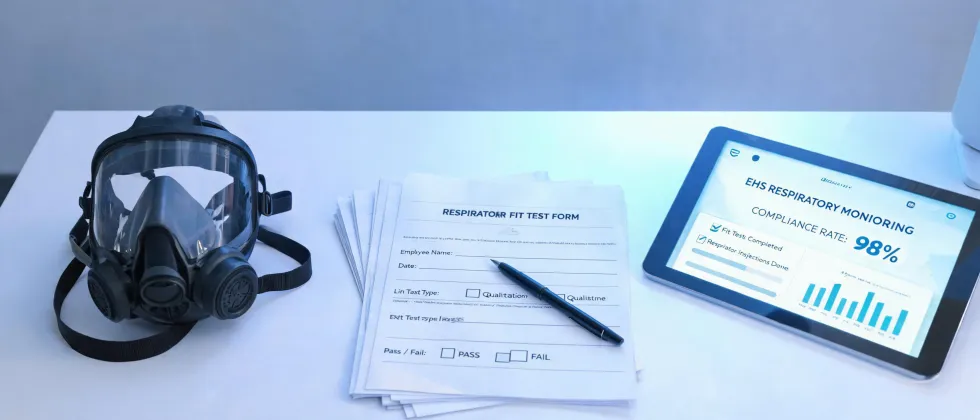
1. Fit testing costs don't scale linearly with low-quality equipment. We tried a budget half mask once (no 3M label). It passed QLFT for most people? No. It failed for 6 out of 20—and each failure costs 30 minutes of training time plus the cost of trying another model. That's not free.
2. Sealing isn't a checklist item. A respirator can be NIOSH-approved, but if the facepiece has a stiff seal that digs into the bridge of the nose, workers will adjust it—and any adjustment between sealing surfaces is a leak. We saw a 2.1% OSHA violation citation risk from workers wearing masks crooked to relieve pressure. No standard measures that. 3M's facepieces are not perfect, but the failure rate in fit testing was dramatically lower in our trial.
So no, I won't tell you the 3M premium is always justified. But when the downside of seal failure is a lung disease, "cheapest approved" isn't the same as "best value."
Practical Advice: Start With the Work Task, Not the Product KPI
If you're reading this because you're about to buy your first batch of 3M half facepiece reusable respirators, here's my blunt advice:
- Hire a CIH (Certified Industrial Hygienist) to do a real exposure assessment before you buy anything. That's $1,500-$3,000. It's cheaper than the wrong cartridge fleet.
- Buy one unit of each candidate respirator SKU. Do a trial fit test with 10 employees across face sizes. Kill your bias. See which one actually passes.
- Set up a cartridge change schedule in writing before you place the order. Use the 3M service life calculator, not your gut.
- Put one person in charge of the program's inventory and training records. Don't split it across three supervisors.
- Track TCO per worker-hour, not per cartridge. That's the metric that tells you if the program is healthy.
Is this overkill for a small shop with one guy spraying paint twice a year? Maybe. For any operation with 20+ employees in respiratory protection, it's the difference between a program and a box of supplies.
So—Would I Buy 3M Again?
I'll probably get flak for this, but: I'd consider the 3M half facepiece reusable respirator the default option, not the automatic option. The default because the fit testing data, cartridge availability, and reliability are proven at scale. Not automatic because if your hazard profile is simple, a cheaper approved alternative might serve you just fine—and you should feel okay saying that out loud.
That's the thing about professional expertise. It's not about loyalty to a brand or worshipping the cheapest quote. It's about knowing where the line is between spending and value. The 3M line is usually a safe place to stand. But it's not the endpoint. The endpoint is a respiratory protection program that survives contact with reality—hot days, tired workers, supply chain hiccups, and all.
And if your vendor won't tell you where their limits are, you're not buying a partner. You're buying a sales pitch. That's the one investment I'd never renew.
