Look, I'm not going to tell you that cheap safety equipment is always junk. It isn't. I've used generics that worked fine. But four years and roughly $3,200 in documented mistakes have taught me one thing: the safety gear you choose tells your customer who you are. Whether you want it to or not.
I manage supplies for a mid-sized contracting crew. I order everything from 3M industrial adhesive to replacement hard hats to daily-wear work gloves. In my first year (2017), I made the classic mistake: I saw "similar specs" on a cheaper alternative and bought it. Twice. The lesson didn't stick until September 2022, when a client watched one of my decisions fail in real time.
Here's what went wrong, what it cost, and why I now specify 3M products without thinking twice.
Mistake #1: The Low-Bid Respirator That Stopped Our Job
Commercial renovation. Tight timeline. A lot of drywall sanding. Five crew members needed respirators, and I was in a hurry—so I bought a non-3M alternative with specs that looked right on paper. The price: about $140 less per case.
The fit was wrong from day one.
Figuring out the root cause was an exercise in frustration. Was the nose clip too stiff? Strap tension wrong? Sealing surface material different? Probably all of the above. But nobody has time to troubleshoot a mask that's supposed to be ready to wear. It either seals, or it doesn't.
Two guys said they could taste dust through the seal. Another guy's glasses fogged no matter how he adjusted the nosepiece. One guy developed a cough—whether that was directly from the respirator failure, I can't say for certain. But the client saw him coughing on their site and started asking questions. Questions I didn't love answering.
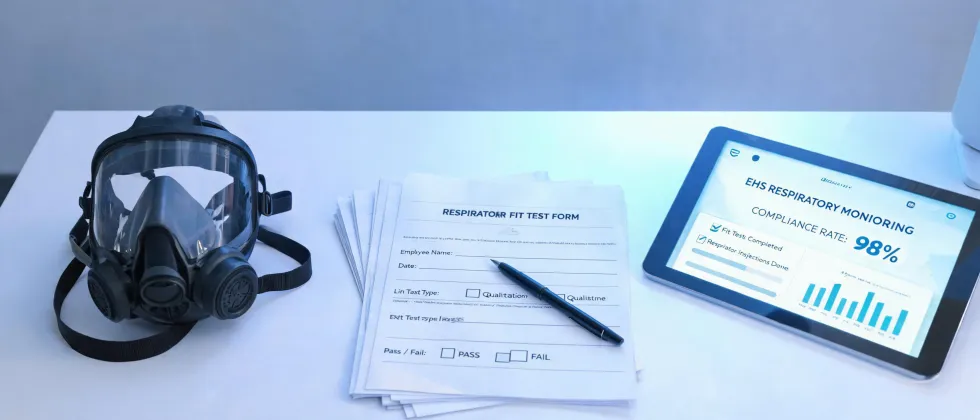
I ordered the 3M Performance Drywall Sanding Respirator that same afternoon. $650 with expedited shipping. (Yes, we should have done formal fit testing. We do now.) The old masks went in the trash.
The difference wasn't the spec sheet. The 3M respirators fit our crew's faces. They sealed properly. They didn't fog glasses. The quality difference was immediate—and the client noticed we'd corrected the issue, which counts for something. But the four working days of disruption? Those were gone forever.
The modest price difference per case translated to noticeably better client confidence. If I'd spent that money upfront, I would have saved four times that amount in delay costs alone.
Mistake #2: The Adhesive That Failed During QC
This one still stings.
In September 2022, we took on a 320-piece metal sign bonding job. Commercial storefronts, high-traffic area, structural adhesive required. The client specified high heat resistance. My spreadsheet said we could save $35 per case by switching from 3M industrial adhesive to a generic "industrial strength" alternative.
$35 per case. I approved it.
The client was present for the pull test during QC. That's standard practice for them—and normally I welcome it. This time I wished they weren't there. Forty-seven of the 320 pieces showed visible delamination when tested at temperature. The client watched a sign peel off its substrate like a sticker. Then they looked at me.
The rework cost $2,100 in labor. The wasted material was $450. The savings I'd approved for: $140. Let that sink in.
The rest of the job went fine, thanks to the 3M adhesive our crew had used on hundreds of similar projects. But the client never quite looked at us the same way. And honestly? They shouldn't have. We changed a material on their project without telling them.
What I now understand about 3M industrial adhesive: when an application is structural—load-bearing, heat-exposed, customer-visible—you're not paying for a chemical compound. You're paying for decades of field testing and statistical certainty that it will hold. The generic product might work. It might also fail at the worst possible moment. "Might" is not a load-bearing material.
Mistake #3: We Armed Ourselves for the Wrong Threat
This lesson didn't come with an invoice. It came with a realization about how we perceive risk.
A crew member asked me to order bear spray after a coyote was spotted near the jobsite parking lot. I bought it without thinking. Then I got curious and looked up the difference between bear spray vs pepper spray. They're not the same. Bear spray is a fogger, designed to create a wide barrier at a distance. Pepper spray is a targeted stream with a different formulation for human-scale threats. Use the wrong one and you'll find out why the distinction matters—often at exactly the wrong moment.
Both products make strong claims, and per FTC guidelines, those claims have to be truthful and substantiated. That's fine as far as it goes. It doesn't help you pick the right tool for a suburban parking lot with coyote sightings.
The same week, a facility manager at another site was deeply concerned about a fence lizard population near their building entrance. Traps. Pest control visits. Meetings about habitat modification. Meanwhile, his crew was grinding steel ten feet away without eye protection or hearing protection. The lizard was new, visible, and unsettling. The grinding was routine, boring, and dangerous. He'd worked with it for years without an accident—which, statistically, made him lucky, not safe.
I've thought about that moment a lot. It's not that the manager was irrational—a fence lizard presence can indicate other pest issues. But the gap between the attention he gave the lizard and the attention he gave his crew's grinding operations was enormous. And that same gap shows up in our equipment decisions.
That's the trap most of us fall into. We buy equipment for the risks we can imagine, not for the risks we actually have.
Even now, the pink hard hat story reminds me of this. We ordered a batch of pink hard hats because they were on sale. They're the same ANSI Z89.1-rated shells as any other color and meet the same standards. But on the first day at a client site, the safety manager raised an eyebrow. Pink hard hats carry meaning in construction—some crews use them as a penalty for safety violations, others use them for breast cancer awareness campaigns. Choose them by accident, and you're sending a message you didn't intend.
Visible choices carry messages. That's the whole point of my $3,200 education.
But Wait—Is 3M Always the Answer?
Here's the objection I expect: "Brand-name safety products are overpriced. There are just as good alternatives."
You're right—for certain things. I still buy generic work gloves, generic safety glasses, generic earplugs. Non-critical gear where the brand is just a logo, not a reliability signal. But for equipment that protects someone's lungs, bonds something structural, or signals professionalism to a client, the price difference is a rounding error compared to the cost of failure.
Generic gear works best when the stakes are low. Maybe you're protecting against a scrape or a splash. But when the risk is silicosis, a failed bond, or a dropped load, that's when you want the product that's been tested in every environment, with documentation to prove it.
I can only speak to my context: a mid-sized contractor doing commercial renovations in a market where clients check quality firsthand. If you're a solo operator doing residential work where no one inspects your gear, the calculus might be different. Your mileage may vary.
But for us, the checklist now has one question at the top, before any purchase order gets approved:
"Would I feel comfortable explaining this purchase to a client while they're watching?"
If the answer is no, we spring for the 3M version. Because I've been the person on the other side—explaining a $140 savings that cost me $2,550 in rework, credibility, and delays. It isn't a math problem. It's a reputation problem.
Since then, we've caught 47 potential equipment errors using that checklist. That's not a brag—it's a confession of how easy it is to slip.
That's the thing you can't put in a spreadsheet: the cost of looking unprofessional in front of someone who decides whether you keep their business. Three mistakes, $3,200 in direct losses, and one very expensive education. I'm finally done with tuition.