Can Pepper Spray Damage Your Eyes? The Short Answer
In my role coordinating emergency PPE deliveries for industrial sites, I've taken more late-night calls than I can count. One that still sticks with me happened in March 2024, just before 11 p.m. A site supervisor was on the line: a worker had taken a direct hit of pepper spray to both eyes. The crew had already rinsed his face with bottled water, but no one could tell me if the eyewash station was functional. The only eye protection on site was a box of basic safety glasses—the kind that look tough but leave gaps around the edges.
When I asked that supervisor, "Can pepper spray damage your eyes?" his first answer was, "It's temporary, right?" That's the exact mindset that leads to serious eye injuries. Pepper spray—oleoresin capsicum spray—causes immediate tearing, burning, and involuntary eyelid spasm. Most of the time, symptoms fade within 30 to 60 minutes. But a direct exposure can also cause corneal abrasions, chemical conjunctivitis, and in more serious cases, increased pressure inside the eye. If someone wears contact lenses or already has a compromised cornea, the outcome can be much worse.
The Deeper Problem: What PPE Doesn't Do
The real issue isn't pepper spray. It's the gap between what workers think their PPE does and what it actually does.
Here's something PPE vendors won't tell you: safety glasses and goggles are not interchangeable. 3M safety glasses, for example, are excellent for impact protection. They'll stop a chip or a small fragment. But they are not designed to seal around your face. A liquid spray or fine mist can slip in around the edges and hit the eye. If your hazard list includes chemicals, paints, solvents, or pepper spray, you need sealed goggles or a full-facepiece respirator. I've visited too many sites where the entire eye protection program is a wall of basic safety glasses.
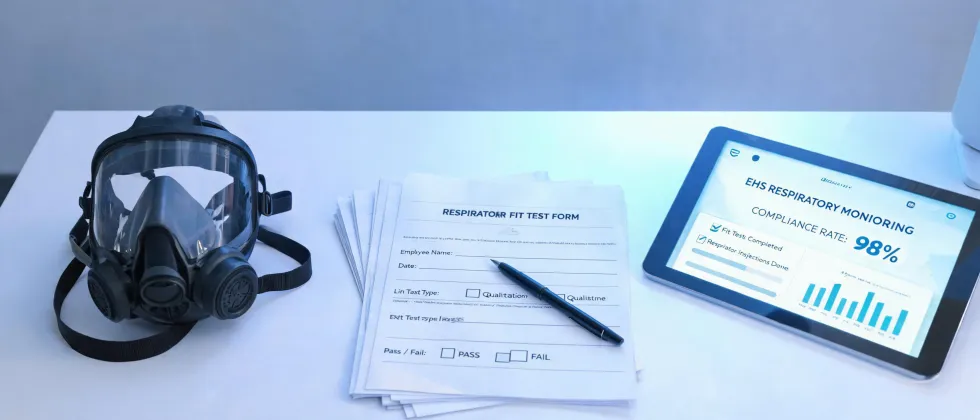
The same logic applies to respiratory protection. An N95 mask is a particle filter. It does nothing for your eyes and nothing for organic vapors. If pepper spray is aerosolized with a solvent carrier, an N95 will let those vapors straight through. A 3M half facepiece reusable respirator with the right cartridge can handle particles and certain vapor exposures, but it still leaves your eyes fully exposed. Only a full-facepiece respirator covers both.
Then there's the transfer route, which people rarely consider. Pepper spray residue settles on gloves, sleeves, and cloth masks. When a worker rubs their eyes—which people do without thinking—the chemical is introduced directly onto the cornea. In my opinion, this is how most "mild" exposures turn into eye injuries.
And that black chain link fence around the site? It keeps unauthorized people out, but it doesn't control the air. An aerosol cloud can drift straight through it. I've watched safety managers treat a perimeter fence as if it creates a safe zone. It doesn't. Physical barriers have their place, but they're not a substitute for ventilation, distance, and the right PPE.
The Cost of Getting It Wrong
Let's put a number on it. A chemical eye injury can mean corneal epithelial defects, conjunctivitis, and sometimes a dangerous spike in intraocular pressure. The standard first aid is at least 15 minutes of continuous flushing with clean, lukewarm water or saline. If the eyewash station is empty, or located 200 feet away behind a locked gate, those minutes turn into more damage. I'm not an ophthalmologist, so take the medical jargon with a grain of salt, but the cases I've seen on the ground match what the literature describes as chemical keratoconjunctivitis.
Financially, the tab can hit five figures: a workers' compensation claim, an OSHA citation for missing or inadequate eyewash facilities, and a stalled crew. The cost I see most often is time. Pepper spray exposure doesn't just affect one worker—it stops a whole shift. A minor accident becomes a project delay, and a project delay can become a penalty clause.
Last year, I processed a rush order for a client whose previous supplier had sold them "all-purpose safety glasses" for a job that involved chemical mixing. We paid about $300 for overnight delivery of ANSI Z87.1-rated goggles and sterile saline kits. The client's alternative was a likely ER visit, an entire day of lost production, and a potential $50,000 contract penalty. That's not a $300 expense. That's a $300 investment that saved them from a six-figure mistake.
It took me roughly eight years and over a hundred PPE failure reviews to understand a simple truth: most PPE failures aren't equipment failures. They're selection failures. The product was tested, approved, and shipped—but it was the wrong product for the hazard.
What Actually Works (With One Honest Caveat)
So what do we do differently? Start with the hazard, not the product catalog. Ask what is actually in the air, on the skin, or at risk of hitting the eyes.
For eye protection, use safety glasses only for impact hazards. For liquid splashes, mists, or sprays, use sealed goggles or a full-facepiece respirator, and look for the ANSI Z87.1 mark on the packaging. 3M has a full range of these options; the right one depends on your specific chemical exposure, not on what's comfortable or cheapest.
For respiratory protection, an N95 mask is fine for nuisance dust on many dry sites, but it's exactly what it sounds like: particle filtration only. If you're dealing with organic vapors, solvents, or chemical aerosols, step up to a 3M half facepiece reusable respirator with the correct cartridge. And remember: a half facepiece leaves your eyes uncovered. If the hazard is both respiratory and ocular, you need full coverage.
Per FTC guidelines (ftc.gov), manufacturers have to be able to substantiate claims about what their PPE does. That's why legitimate respirators carry NIOSH approval numbers and goggles reference the ANSI Z87.1 standard. The label is your first clue. If a product doesn't clearly state what it protects against, treat it as unreliable.
Here's the caveat, and I want it stated plainly: there is no single "best" product for every site. I'm not going to tell you that all 3M safety gear is universally the answer, because the right answer depends on the hazard, the work environment, and the training level of the crew. What I will say is that the most expensive PPE in the cabinet is the one that failed because it was the wrong type. The cheap eyewash kit that never gets checked? That's expensive. The safety glasses that look professional but let a mist through? Expensive. The N95 used for solvent vapors? Very expensive.
Better Prepared, Not Perfect
Pepper spray in the eye isn't a freak accident. It's a predictable result of a PPE selection gap. The fix isn't complicated—test your eyewash stations, buy goggles that actually seal, put the right cartridge on the respirator, and train workers on how to remove contaminated PPE without touching their faces. But first, you have to understand why the old assumptions don't work. I've been on too many midnight calls to let that slide.
