The day I accidentally became the safety buyer
Last January, our safety coordinator left, and the owner handed me the storage-shed key. I’m the office administrator for a fence contractor in western Ohio. We put in commercial chain link, ornamental aluminum, and a lot of vinyl picket fence around subdivisions and utility sites. I normally manage office purchasing—roughly $80,000 a year across eight vendors. Adding “safety supplies” to my list shouldn’t have been a problem. Then I opened the shed.
There were three boxes of masks, and none of them had lid inserts. There was a bin of 3M respirator cartridges with no labels. There was a hard hat with a cracked shell and duct tape on the suspension. In the first-aid cabinet sat a canister labeled Mace next to a bottle of expired ibuprofen. It looked less like a PPE program and more like the aftermath of a garage sale.
I told the owner I would keep ordering the same things. I couldn’t, because I didn’t know what the same things were for. The first real question wasn’t “Which 3M product?” It was “What hazard are we actually protecting someone from?”
What the “3m dust mask” label really means
Take the phrase “3m dust mask.” It seems simple. But for our crews who cut vinyl picket fence and sweep out post holes, it could mean a NIOSH-approved N95 respirator, or it could mean a mask that is not a respirator at all. The word “dust” makes it sound harmless either way. The printed standard on the package is what separates the two.
Our dusty work mostly fell into the N95 category—a 3M filtering facepiece respirator was the right class for those crews. But I caught myself about to hand the same type of mask to the shop foreman, who was about to spray solvent-based primer on steel. N95 respirators filter particles, not organic vapors. A mask is not a chemical cartridge. That was the moment I moved from ordering “the usual box” to reading the application.
Why “3m respirator cartridges” aren’t one purchase
When I searched “3m respirator cartridges,” I got pages of options: organic vapor, acid gas, P100, multi-gas/vapor, combination cartridges. None of them had a tag saying “buy this one for everything.” A cartridge is selected for a chemical, not for a category.
One day I stood in our shop with a safety consultant and looked at four tasks: cutting PVC, grinding metal, painting with solvent, and working near solvent-based adhesive. Only two of those needed chemical cartridges. For grinding, P100 particulate filters were enough. For the solvent job, the consultant specified 3M 6001 organic-vapor cartridges on a half-mask respirator. The moment we started writing the application on the order instead of writing “cartridges,” the mistakes dropped.
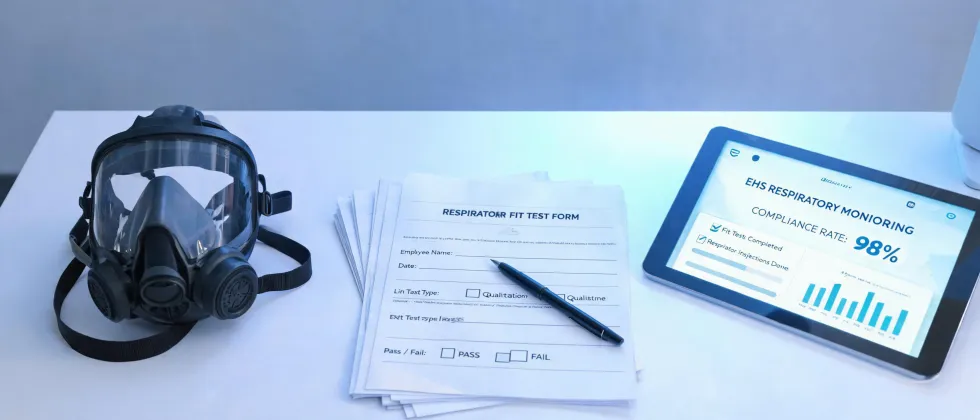
I’m not an industrial hygienist, so I don’t recommend cartridges to anyone. I recommend asking someone who does this for a living. A respirator isn’t a vending-machine product. It comes with fit testing, training, and a program behind it. The cartridge was never the whole answer.
The Milwaukee hard hat test
A crew leader had been on a site where another contractor wore a Milwaukee hard hat. He asked if we could order five. I ordered one first. That felt weird—testing a hard hat like it was a truck. But it made sense after the safety meeting.
The Milwaukee hard hat was comfortable. The ratchet was easy to adjust even with gloves, and the shell looked solid. If I was judging only by how it felt on a head for five minutes, it would have won. The reason we did not order five was the rest of our safety system. The 3M headgear we already used had a mounting system for face shields and earmuffs. The Milwaukee hat did not share that same bracket system. For a one-job crew, that is not a problem. For our inventory, it meant extra parts, extra SKUs, and more to check at toolbox talks.
I want to be clear: the Milwaukee hard hat is a good product. We still keep one as a spare in the truck. The decision was about system integration, not brand quality.
So, what’s the difference between pepper spray and mace?
While I was handling hard hats, the receptionist asked me what’s the difference between pepper spray and mace. I had typed the same question into my phone a week earlier. Here’s the short buyer-specific answer:
The original Mace was a brand name for a defensive spray made with CN, a tear gas. Pepper spray is made with OC, the oily resin from hot peppers. CN causes tearing and a burning sensation. OC causes intense burning and involuntary eye closure. Different formulas, different effects. To make it more confusing, the word mace is now used generically, and some canisters with Mace printed on them actually contain OC. The label is the only way to know.
I’m not a lawyer or a security trainer, so I didn’t guess. We checked with local law enforcement and our insurance company before stocking anything at the front desk. That one phone call saved us from making the same mistake I almost made with the masks: buying a category instead of a solution.
What I would do differently
If I had this to do over, I would start with a two-page hazard list instead of a shopping cart. Ask every supervisor what work creates dust, vapors, noise, falling objects, or security risk. Then buy supplies around that list. The idea sounds basic, but the old way was product first and hazard later.
I still kick myself for almost issuing a respirator to a new hire before checking fit-test records. I didn’t make that mistake only because the foreman caught it. It wasn’t the cartridge that almost failed; it was the process.
The supply shed now makes me disproportionately happy. Every bin is labeled with an application. The 3M box says “Dust—N95 only, no paint.” The cartridge bin says “OV/P100, only after fit test.” The label next to the office spray says “OC, not CN. Do not spray indoors.” For a person whose job is mostly purchase orders, that clarity is the win.
This was accurate as of spring 2025. Standards and products change, so treat this as a buying story, not as a substitute for a professional hazard assessment.