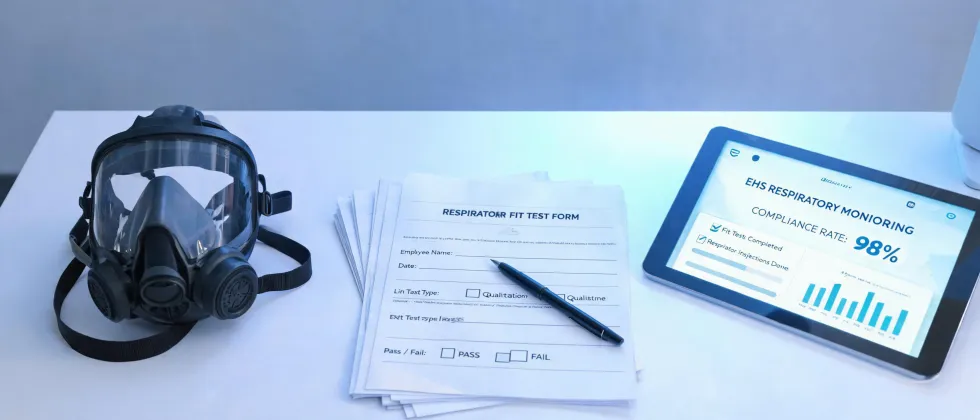
Here’s the short version: if your company is buying cheap respirators to save money, you’re actually costing yourself more. I learned this the hard way when I took over purchasing for a 400-person manufacturing company in 2020. And the 3M 6200 half facepiece respirator—specifically—became the case study I now use to teach our new procurement staff about TCO.
I’m not a safety engineer. I’m not a certified industrial hygienist. I’m the admin who manages 60-80 orders annually across 10 vendors, responsible for everything from office supplies to construction PPE. And in 2022, I inherited a mess: three different respirator brands across three locations, no standardization, and inconsistent compliance. My VP asked me to “fix the PPE budget.” What I found surprised me.
The $500 Mistake
In early 2023, I approved a purchase of 50 units of an off-brand half-mask respirator at $9.50 each. Compared to the 3M 6200 at ~$25 per unit, I was patting myself on the back. Saved the company $775 upfront. Felt good.
Three months later, here’s what actually happened:
- 15 units returned because the face seal leaked. Workers complained about dust getting in. Replacement cost: $142.50.
- 8 units damaged because users overtightened the plastic yoke. No replacement parts available—unlike 3M’s modular design. Had to replace entire units: $76.
- 22 users required retraining because the fit test failed. Two nurses had to redo the program. That’s roughly $880 in staff time (at $20/hr × 2 hours per person).
- 6 workers stopped wearing them. They just pulled them down. Now I had a compliance issue.
Total hidden cost: ~$1,098. The $9.50 respirator ended up costing us $21.96 per unit after all that. Compare to the 3M 6200, which cost ~$25 upfront and zero replacement/retraining costs across the same period. The 3M option was actually cheaper in 3 months. But from the outside, it looked expensive.
This is exactly what I mean by TCO. People assume the lowest quote means the vendor is more efficient. What they don’t see is which costs are being hidden or deferred. (Note to self: always include retraining and compliance costs in the calculation.)
Why the 3M 6200 Works
From a procurement standpoint, the 3M 6200 has three features that matter more than the price tag:
1. Compatibility
The 6200 accepts 3M’s entire 6000-series filter line—particulate, organic vapor, acid gas, combination cartridges. For us, that means one facepiece for 90% of our hazards. Not ideal for every scenario, but workable for a general manufacturing environment. With cheap off-brands, you’re locked into whatever filters they make (if they even have a full line).
2. Replaceability
Individual parts are available. Yoke breaks? $3.85. Exhalation valve gets dirty? $2.10. That’s why our maintenance team likes it—they can fix it instead of tossing the whole unit. (I really should keep better inventory of those parts.)
3. Fit Testing Reliability
We had a 92% pass rate on our qualitative fit test with the 6200. The cheap brand? 74%. That 18% gap meant more retraining, more program costs, and more safety manager headaches. This gets into technical territory I’m not expert in, but our safety consultant confirmed: 3M’s facepiece design has a wider fit range across face shapes. For an admin who cares about compliance, that’s gold.
The Hidden Cost of Compliance
Here’s something people don't talk about: when workers stop wearing PPE because it’s uncomfortable or leaks, you don’t just have a safety problem—you have a compliance problem. If OSHA shows up and sees improperly worn respirators, you’re looking at citations and fines. (This happened to a vendor of ours in 2021. Not fun.)
I can only speak to our situation—a mid-size operation with predictable orders. If you're a seasonal business or dealing with high-turnover labor, the calculus might be different. But for us, buying the 3M 6200 was the cheaper choice even though it cost 2.5x upfront.
“The assumption is that expensive respirators cost more because they’re higher quality. The reality is they cost more because they save you from retraining, replacements, and compliance risks. The causation runs the other way.”
What About Temporary Fencing?
We used temporary chain link fence for our construction site last year. The purpose? Controlling access, keeping unauthorized personnel out, and preventing theft. Same principle as a respirator—the real cost isn’t the equipment itself, it’s what happens when the equipment fails. (Theft of copper piping cost us $3,400 before we got the fence up. Should have done that sooner.)
But that’s a different story. Back to respirators.
What I’d Tell You If You’re On the Fence
If you’re managing PPE procurement for a company with more than 50 workers, and you’re considering the 3M 6200 vs. cheaper alternatives, calculate your TCO. Include:
- Retraining costs (staff time, nurse time)
- Replacement rates (how many units break or get lost)
- Compliance risk (fines, citations, insurance implications)
- Worker productivity (comfort = fewer lazy removals)
Industry standard fit test pass rates (per NIOSH guidelines) recommend 95% or higher for tight-fitting respirators. We’re not there yet, but the 3M 6200 got us close. And for an admin who’s measured on safety metrics, that’s the number that matters.
After 5 years of managing these relationships, I’ve learned one thing: the upfront price is the least interesting part of any procurement decision. The expensive choice is often the cheap one, and vice versa.
So no, I don’t think everyone needs the 3M 6200. But if you’re buying for a facility where worker safety and compliance are non-negotiable, and you want a product that works without constant replacement—then yeah, it’s worth it. Not because it’s fancy. Because it’s cheaper in the long run.
(Based on my experience as an admin managing PPE procurement for a 400-person manufacturing company. Prices as of April 2025. Your mileage may vary.)